

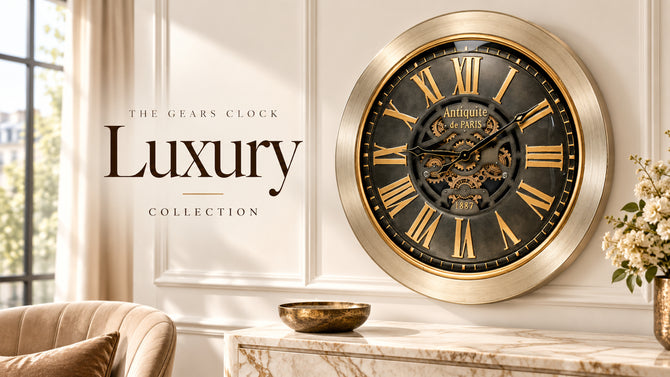










In many homes, wall clocks exist quietly. They tell the time, occupy a small portion of wall space, and rarely receive much attention. They are often chosen quickly, based on convenience rather than intention. Yet in carefully designed interiors, a wall clock can play a completely different role. It can become a design statement, an object that defines the atmosphere of a room instead of merely serving it.
Understanding what turns a wall clock into a statement piece changes the way we look at wall decor. It shifts the focus from utility to presence, from function to identity. In the living room especially, where design choices are most visible, a wall clock has the potential to become one of the most powerful elements in the space.

The Difference Between a Clock and a Statement Piece
A functional clock answers a simple question: what time is it.
A statement clock answers something deeper: what kind of space is this.
Statement clocks are chosen deliberately. They are not fillers or last-minute additions. They are anchors that bring structure, balance, and personality to a room. When someone enters a living room and their eye is naturally drawn to the clock, not because it is loud or flashy but because it feels right, that clock has crossed the line from object to design element.
Presence Is More Important Than Decoration

Presence does not mean excess. It means confidence.
A statement wall clock holds its space on the wall effortlessly. It does not compete aggressively with furniture or decor, yet it does not disappear either. Its presence comes from proportion, material, and thoughtful placement rather than ornamentation.
In modern living rooms with large, open walls, presence is essential. Without it, the space can feel unfinished. A well-chosen clock gives visual structure and anchors the room.
Scale Changes Perception

Scale is one of the most underestimated tools in interior design.
Small clocks often disappear, especially in spacious living rooms. Larger clocks, when chosen correctly, fill visual gaps and establish hierarchy. They balance the room and create a focal point without overwhelming it.
A large wall clock above a sofa or console creates a strong vertical axis and gives the room a sense of order. This is one of the reasons why designers often replace traditional wall art with statement clocks.
Materials That Communicate Value

Materials speak before form is fully understood.
Lightweight or synthetic materials often suggest convenience. Solid materials suggest intention, durability, and craftsmanship. A statement clock almost always relies on materials that feel real and substantial.
Metal frames, bronze finishes, textured surfaces, and exposed mechanics immediately elevate perception. These materials interact with light throughout the day, subtly changing appearance and keeping the clock visually engaging.
Many homeowners looking to elevate their living room decor are naturally drawn to wall clocks with real moving gears, as they combine material richness with authentic mechanical character.
wall clocks with real moving gears
Why Movement Creates Emotional Impact

Unlike static decor, a wall clock is alive.
The movement of the hands, and especially the rotation of visible gears, introduces rhythm into a room. This motion draws attention gently, without sound or intrusion. It creates a calming, almost hypnotic effect that enhances the atmosphere of the living space.
Clocks with real moving gears are often perceived as more valuable, even subconsciously. They suggest mechanical honesty and a connection to traditional craftsmanship, which is why they are frequently chosen as statement pieces rather than background decor.
Statement Clocks as Functional Art

One of the most interesting shifts in interior design is the move away from purely decorative wall art toward functional design elements.
A statement wall clock decorates the space while serving a purpose. It fills wall space, adds movement, and contributes to the identity of the room without feeling purely ornamental. This dual role makes it especially appealing in living rooms, where every element should earn its place.
Designers increasingly choose statement gear wall clocks to replace paintings or prints, creating walls that feel both intentional and alive.
Style Alignment and Design Coherence
A statement clock works best when it aligns with the overall style of the room.
In modern interiors, clean silhouettes and controlled color palettes allow the clock to stand out through form and material. In industrial spaces, exposed gears and metal finishes feel natural and authentic. In transitional or vintage-inspired interiors, classic numerals and warm textures bridge old and new.
The key is coherence. A statement clock should feel bold, but never random. It should reinforce the identity of the space, not compete with it.
Longevity Over Trends
True statement pieces are not trend-driven.
While colors and finishes may evolve, a well-designed wall clock remains relevant because its value lies in proportion, materials, and mechanical integrity. These fundamentals do not go out of style.
This longevity makes statement clocks a meaningful design investment. They grow with the space and remain relevant even as furniture and decor change.
Final Reflection

A wall clock becomes a design statement when it is chosen with intention. When its scale respects the space. When its materials feel authentic. When its movement adds life rather than noise.
At that point, it is no longer just a timepiece. It becomes a defining element of the room, quietly shaping atmosphere, identity, and experience.
The most compelling interiors are not filled with objects. They are composed of pieces that matter. A statement wall clock is one of those pieces.


I love the clock on the page “Scale Changes the Perception.” Where can I locate this clock on your website. It is perfect. I’m looking for a wall clock for a church entry in memory of my husband. Our church is traditionally style but the entry has a touch of contemporary. I think one of 24 to 27 inches would be perfect. Not too big and not too little. Send me your suggestions.