

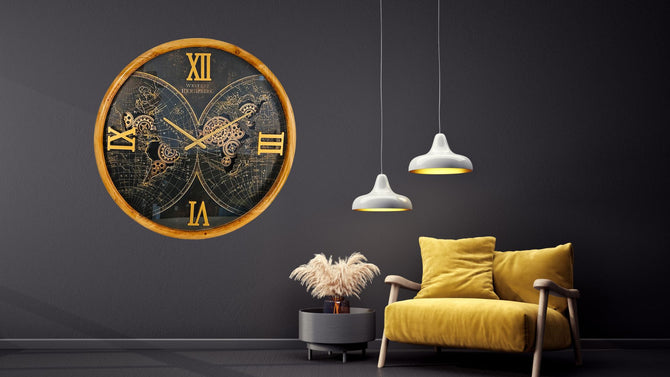










You spent real time choosing a statement wall clock — maybe the Austria Line "Vienna" with its warm brown wood-look ring and brushed-silver bezel, or the bold rectangular Norway Line "Trondheim" at 27 × 19 inches. Once it's on the wall, the natural instinct is to stop thinking about it. And for the most part, that's exactly right — these clocks are built to run quietly and reliably for years with minimal fuss.
But there's a silent category of damage that takes even premium wall clocks out of commission long before their time: environmental stress. Heat, humidity, direct sunlight, and wild temperature swings don't announce themselves the way a bad drop does. They work slowly — warping materials, degrading lubricants inside the movement, fading finishes, and eventually making a precision timepiece look and behave like something far cheaper than it is.
This article isn't about dramatic accidents. It's about the placement decisions most people make without thinking — and how a few small adjustments can mean the difference between a clock that lasts a decade and one that lasts a lifetime.
Why Moving-Gear Clocks Are More Placement-Sensitive Than Standard Wall Clocks

Click here to Shop the AUSTRIA LINE WALL CLOCK ROUND 26 INCH "GRAZ" BROWN-WHITE
A standard wall clock with a single quartz movement and a flat face is a fairly contained system. A moving-gear clock is something more complex: multiple gear trains operate simultaneously, often with the decorative gears running on a secondary mechanism entirely separate from the timekeeping movement. That's why, on clocks like the England Line 24-inch Silver Grey or the England Line Ocean Blue, you'll find that the hands and the visible gears each run on their own battery circuit — two distinct systems working in concert.
That added mechanical sophistication is what makes the hypnotic motion possible. It's also what makes environmental conditions more consequential. More moving parts means more surfaces that can expand with heat, more lubricants that can thin or congeal, and more precision tolerances that can drift when materials change shape. The glass cover found across the Austria Line, Norway Line, Sweden Line, and England Line clocks does offer a layer of protection — but it is not a sealed environment. Air, humidity, and temperature all find their way in over time.
Understanding this doesn't require an engineering degree. It just requires knowing which rooms and wall positions create the conditions that shorten a clock's life — and which ones let it thrive.
The Three Environmental Enemies: Heat, Humidity, and UV Light

Click here to Shop the NORWAY LINE WALL CLOCK ROUND 24 INCH "KRISTIANSAND" BRASS-GOLD
Heat is probably the most underestimated threat. Quartz movements are calibrated to perform within a moderate temperature range — typically somewhere between 50°F and 95°F (10°C–35°C). At the outer edges of that range, the crystal oscillator inside the movement can begin to drift, causing the clock to run slightly fast or slow. Beyond that, heat softens adhesives used in the movement assembly, and over years it degrades the rubber gaskets and plastic components found even in high-grade quartz mechanisms.
Common heat sources to keep away from your clock: the wall directly above a radiator or baseboard heater, the wall beside a wood-burning fireplace (not just above it — radiant heat spreads sideways), and any exterior-facing wall that gets significant direct solar gain in an uninsulated space. In kitchens, the wall directly beside or above a stove generates intermittent but intense heat that wreaks havoc on both the movement and on wood-look finishes like those on the Austria Line "Graz" (26-inch, brown wood-look ring).
Humidity is the most region-specific concern. Coastal homes, bathrooms, laundry rooms, and kitchens during cooking all generate elevated humidity. Moisture infiltrating a clock's interior causes metal components to oxidize, wood-look surfaces to swell and warp, and electrical contacts in the battery compartment to corrode. The Sweden Line "Uppsala" — a 22-inch round clock with a genuine leather ring in black-pink — is particularly worth protecting from humidity, since leather responds to moisture more visibly than metal or composite materials, stretching and discoloring with repeated wet-dry cycles.
UV light is the slow fade artist. Direct sun hitting a clock face for several hours a day will bleach dial colors and degrade plastic lenses over months, not years. The brushed-silver bezels and glass covers across The Gears Clock range offer some resistance, but no finish is immune to sustained UV exposure. The white dial of the Norway Line "Trondheim" (27 × 19 inches rectangular) is especially susceptible — white faces yellow unevenly, starting at the edges and working inward, producing a patchy aged look that's very different from the dignified patina of true antique brass.
The Rooms and Positions Where These Clocks Thrive

Click here to Shop the NORWAY LINE WALL CLOCK RECTANGULAR 27 X 19 INCH "TRONDHEIM" SILVER-WHITE
The good news is that the vast majority of interior walls in a typical home are perfectly hospitable environments for a moving-gear clock. Here's how to identify the genuinely good spots.
Living rooms are ideal in almost every case, provided you avoid the wall directly above a fireplace (the mantel wall gets hot during use) and any wall with a large west-facing window that delivers intense afternoon sun without a blind or curtain. An interior wall — one that doesn't face outside directly — tends to have the most stable temperature and humidity year-round. A large statement piece like the Norway Line "Kristiansand" (24-inch round, brass-gold finish) looks extraordinary centered on an interior living room wall where it receives ambient light but no direct beam.
Entryways and foyers work beautifully, with one caveat: exterior-facing entry walls in cold climates can experience condensation when the front door opens repeatedly in winter, pulling cold, dry air against a warm interior surface. If your entryway has this issue, choose an interior foyer wall instead of the wall directly opposite the front door.
Home offices are among the most consistently safe environments — controlled temperature, low humidity, and typically indirect or northern light. The England Line 24-inch Ocean Blue reads especially well in a focused work environment, where the moving gears provide a visually calming backdrop without the distraction of a phone or screen.
Bedrooms on interior walls with no HVAC vent directly blowing at the clock are also excellent candidates. Moving-gear clocks with quiet quartz movements — the standard across all Gears Clock lines — produce no audible ticking, making them genuinely bedroom-friendly from a sound perspective. Environmental conditions in most bedrooms are mild and consistent, exactly what a precision movement prefers.
Where to Actively Avoid Hanging a Moving-Gear Clock

Click here to Shop the SWEDEN LINE WALL CLOCK ROUND 22 INCH "UPPSALA" LEATHER BLACK-PINK
Some locations are genuinely risky, and no amount of careful cleaning or maintenance will compensate for a bad position.
- Directly above a stove or range hood. Even with ventilation, the wall above a kitchen stove experiences grease-laden steam, intense heat spikes, and rapid temperature cycling every time cooking happens. This environment will degrade every material in a clock's construction — finish, movement, lens, and battery contacts — faster than anywhere else in a home.
- In a bathroom with a shower or bathtub. High-humidity bathrooms are not suitable environments for any precision timepiece. A powder room (toilet-only, no shower) with good ventilation is acceptable, but a full bathroom where steam regularly fills the space is not.
- On an uninsulated garage wall or workshop. Temperature extremes in unheated or uncooled garages — especially in climates with cold winters or hot summers — go well beyond the operating range of a quartz movement. A garage might seem like a practical place for a utilitarian clock, but a moving-gear wall clock belongs indoors in a climate-controlled environment.
- Directly in front of a south- or west-facing window with no window treatment. Even a few feet of distance doesn't fully protect a clock if it falls within the beam of direct afternoon sun for several hours daily. Sheer curtains, blinds, or UV-filtering window film make a significant difference if this is the only available wall.
- Beside or above an exterior door in a cold climate. The thermal cycling — cold when the door opens, warm when it closes — stresses materials and movement lubrication repeatedly over a winter season.
None of this is meant to make placement feel complicated. In practice, if a wall is comfortable for a human being to sit beside year-round — not too hot, not too damp, not blasted by sun — it's comfortable for your clock. The problem locations above stand out precisely because they're uncomfortable for people too.
Ongoing Environmental Maintenance: What You Can Do After Hanging

Click here to Shop the ENGLAND LINE WALL CLOCK ROUND 24 INCH SILVER GREY
Once your clock is in a good position, a small amount of periodic attention keeps it performing as it should. None of this requires tools or technical knowledge — it's closer to the attention you'd give a piece of quality furniture.
Seasonal battery checks matter more than most people realize. Batteries that are left in a clock too long — especially in humid environments — can leak, and battery acid is one of the fastest ways to destroy a movement from the inside. Rather than waiting for a clock to stop, change batteries proactively: once a year for the timekeeping movement, and check the decorative gear battery at the same time. Use alkaline batteries from reputable brands, and never mix battery ages or brands in the same compartment.
Dust the glass cover and frame periodically with a dry or very slightly damp microfiber cloth. Dust accumulation on the glass lens of a clock like the Austria Line "Vienna" — with its glass cover protecting the gear display — isn't just cosmetic; fine particulate that works its way into the frame edge can eventually reach moving components. A light dusting every few weeks takes less than a minute.
If you live in a genuinely humid climate — coastal, tropical, or a region with consistently high summer humidity — consider placing a small silica gel packet behind the clock or inside any accessible compartment. These inexpensive desiccants absorb ambient moisture and are widely available at hardware stores. Replace them every six months.
When seasons change, take sixty seconds to glance at the clock's performance: does it still show the correct time, are the gears turning smoothly, does the battery compartment look clean? Early detection of a battery starting to swell or a movement running slightly fast is far easier to address than a crisis that's been developing for months unnoticed.
A moving-gear wall clock at its best is a living element in a room — the kind of piece that people notice and comment on years after it was first installed. The environmental habits above aren't burdensome; they're simply the small acts of care that let a premium clock stay premium for as long as you own it.

Click here to Shop the ENGLAND LINE WALL CLOCK ROUND 24 INCH OCEAN BLUE
Shop the collection: CLOCK BY COLOR - BROWN · Austria Collection
Keep exploring:
- How to Hang a Moving-Gear Wall Clock: Wall Choice, Height, and Hardware
- The Best Housewarming Gift That Isn't a Candle: Why a Moving-Gear Wall Clock Changes a House Into a Home
- How to Clean a Moving-Gear Wall Clock the Right Way
Frequently Asked Questions
Can I hang a moving-gear wall clock in a kitchen?
Yes — with placement care. Avoid the wall directly above or beside the stove, where heat and grease-laden steam concentrate. An interior kitchen wall away from cooking zones, ideally not in the direct path of steam from the kettle or pot, works well. The same goes for any kitchen with an open layout: position the clock on the dining or lounge side of the space rather than the cooking side.
How do I know if my clock's position is causing it to lose time?
If a properly batteried quartz clock begins drifting — gaining or losing more than a minute per month — temperature is one of the first things to investigate. Try moving the clock to a more climate-stable wall for a month and compare. If the drift corrects itself, the original position was likely too warm or experiencing temperature swings. Fresh batteries from a new pack should be ruled out first, as weak batteries mimic heat-related drift symptoms.
Do I need to do anything special when going away for an extended period?
If you're leaving home for more than a few weeks — especially in a season when the home may be unheated or uncooled — it's worth removing the batteries before you leave. This eliminates any risk of battery leakage during your absence and keeps the movement in a stable, resting state. When you return, install fresh batteries and reset the time. This is especially good practice for the decorative gear battery, which some owners forget entirely until it fails.


%20to%20Hang%20Your%20Moving-Gear%20Wall%20Clock:%20Protecting%20It%20from%20Heat,%20Humidity,%20and%20Light)