










When we look at a clock, our attention is usually captured by the hands, the dial, or the design of the case. Rarely do we stop to think about what is happening behind the surface. Yet inside every mechanical clock lies a carefully orchestrated system of gears, quietly working together to transform motion into time.
Gears are not decorative by nature. They are functional, precise, and essential. They are the reason time can be divided into seconds, minutes, and hours with consistency. Understanding how gears work inside a clock reveals not only the mechanics of timekeeping, but also why mechanical clocks feel fundamentally different from digital ones.

Why Clocks Need Gears at All
Time itself flows continuously. A clock’s job is to divide that continuous flow into equal, readable units. To do this, a clock needs controlled motion.
A power source alone is not enough. Whether that power comes from a wound spring, a hanging weight, or a motor, it must be regulated. Gears exist to control that energy. They slow it down, redirect it, and distribute it evenly throughout the mechanism.
Without gears, a clock would release its energy all at once. The hands would spin uncontrollably and stop almost immediately. Gears turn raw energy into usable, predictable motion.
The Gear Train: The Backbone of Timekeeping

At the core of every mechanical clock is the gear train. This is a sequence of gears connected in a precise order, each one influencing the speed and direction of the next.
The gear train begins at the power source and ends at the hands. Along the way, each gear reduces or increases rotational speed according to its size and number of teeth. Large gears rotate slowly. Smaller gears rotate faster. By combining these differences, clockmakers can create exact time intervals.
This is how a single source of motion can drive multiple hands at different speeds. One full rotation per minute for the second hand. One per hour for the minute hand. One every twelve hours for the hour hand.
Gear Ratios and Mathematical Precision

Gear ratios are the mathematical foundation of clockmaking.
A gear ratio is determined by the number of teeth on two interacting gears. For example, if a gear with sixty teeth drives a gear with thirty teeth, the second gear will rotate twice as fast. Clockmakers use these relationships repeatedly, stacking ratios until the desired timing is achieved.
Precision matters enormously. Even a small error in gear ratio can cause a clock to gain or lose time steadily throughout the day. This is why high-quality mechanical clocks require careful engineering and fine tolerances.
Clockmaking is not just craftsmanship. It is applied mathematics.
The Role of the Regulator
While gears distribute motion, they do not define time by themselves. That role belongs to the regulator.
In traditional mechanical clocks, the regulator is often a pendulum or a balance wheel. It oscillates at a constant rate. Each oscillation releases a controlled amount of energy into the gear train.
Gears translate this regular oscillation into visible movement. In this way, the regulator sets the pace, and the gears carry it forward. Together, they create consistency.
This partnership between regulator and gears is what allows a mechanical clock to keep time without electronics.
Mechanical Gears vs Quartz Systems

Quartz clocks also use gears, but in a very different way.
In a quartz clock, a battery powers a quartz crystal that vibrates at a precise frequency. An electronic circuit counts those vibrations and sends impulses to a small motor. That motor may then drive a simplified gear system to move the hands.
Mechanical clocks rely entirely on physical interaction. No electronic shortcuts exist. Every movement you see is the direct result of energy passing through gears, tooth by tooth.
This physical cause-and-effect is one of the reasons mechanical clocks feel more engaging. You can understand what you are seeing. You can follow the logic of motion.
Why Visible Gears Are So Fascinating

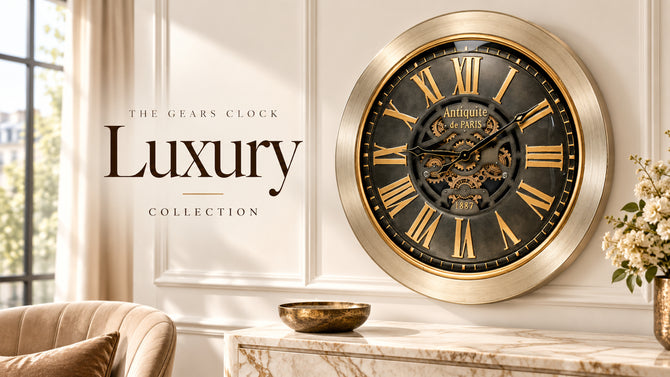
Clocks with visible gears reveal the hidden process of timekeeping.
Instead of hiding the mechanism behind a solid dial, these clocks invite you to observe how time is built. Each rotating gear plays a role. Nothing is abstract. Everything is tangible.
This transparency creates a calming and almost hypnotic effect. Watching gears move at different speeds reminds us that time is layered, not instantaneous.
Many people are drawn to wall clocks with real moving gears because they combine visual beauty with genuine mechanical function, turning timekeeping into an experience rather than a background task.
Here you can naturally link to your collection of wall clocks with real moving gears.
Materials and Their Mechanical Importance
Not all gears are created equal.
High-quality clocks use materials chosen for durability and stability. Brass and bronze are common because they resist corrosion and wear smoothly over time. Steel is used where strength and rigidity are required.
Material choice affects longevity, sound, and performance. Poor materials wear down faster, leading to inaccuracies and noise. Well-chosen materials age gracefully and maintain precision.
This is why mechanical clocks often last decades or even generations when properly made.
Craftsmanship Behind Gear Assembly
Designing gears is only part of the process. Assembly matters just as much.
Each gear must be aligned precisely. Too much friction slows the mechanism. Too little contact causes slipping. Even microscopic imperfections can affect performance.
This is where craftsmanship becomes visible. High-quality clocks feel different because they are built with care. The motion is smooth. The interaction between gears feels deliberate rather than forced.
This human element is something no digital system can replicate.
Common Misconceptions About Clock Gears
A common myth is that more gears automatically mean better quality. In reality, quality comes from design efficiency, not quantity. A well-designed gear train with fewer components can outperform a complex but poorly engineered one.
Another misconception is that visible gears are purely decorative. In many low-quality products, gears are added only for appearance. In genuine mechanical clocks, visible gears are part of the real mechanism and contribute directly to function.
Understanding this difference helps distinguish authentic craftsmanship from imitation.
Why Gear Clocks Feel Like Statement Pieces

Clocks with exposed mechanics naturally attract attention.
Movement, depth, and material create visual interest that static decor cannot match. This is why many designers choose statement gear wall clocks as focal points in living rooms and open spaces.
They combine function, motion, and design in a single object. They do not just tell time. They tell a story.
This is another natural point where you can link to your statement gear wall clock collection.
Longevity and Maintenance
Mechanical clocks require minimal but meaningful care.
Occasional cleaning and proper placement away from extreme humidity or dust can significantly extend lifespan. Unlike electronic devices, mechanical clocks do not become obsolete. They can be maintained, adjusted, and enjoyed over long periods.
This longevity reinforces their value as design objects rather than disposable accessories.
The Philosophy of Mechanical Time
Mechanical clocks remind us that time is not just numbers on a screen.
It is movement. It is rhythm. It is interaction between parts working together. Gears embody this philosophy. Each one depends on another. No gear works alone.
In an age of instant digital feedback, this mechanical honesty feels grounding.
Final Reflection

Gears are the silent architects of time. They transform raw energy into rhythm, motion into meaning. They do not measure time directly, but without them, time could not be measured at all.
Understanding how gears work inside a clock deepens appreciation for mechanical timekeeping. It reveals why these systems have endured for centuries, not just for accuracy, but for beauty.
When you watch gears turning, you are not just observing a mechanism. You are watching time take shape.


