











You've probably heard the pitch for time-blocking: assign every hour of your day a job, protect those blocks from interruption, and watch your productivity transform. Productivity writers love it. Cal Newport built a career defending it. And yet most people who try it quietly abandon it within two weeks — not because the method is flawed, but because of one missing piece: a reliable, frictionless, always-visible way to know what time it actually is.
A calendar app on your phone doesn't solve this. Neither does a smartwatch you have to raise your wrist to read, or a laptop clock buried in the corner of a screen full of notifications. Time-blocking is fundamentally a spatial practice — it asks you to inhabit your day hour by hour — and that requires a time signal that lives in your physical environment, not inside a device competing for your attention. This is where a wall clock stops being decor and starts being a productivity tool.
What Time-Blocking Actually Asks of Your Brain

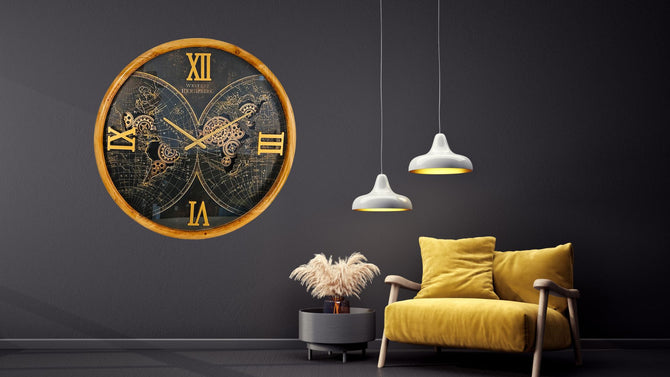
Click here to Shop the ITALY LINE WALL CLOCK SQUARE 36 INCH SORRENTO
The core promise of time-blocking is simple: instead of running a vague to-do list and reacting to whatever feels most urgent, you pre-commit to what you'll work on and for how long. Research on decision fatigue tells us that every time you pause mid-task to ask yourself what should I do next?, you spend real cognitive energy — energy that could have gone into doing the actual work. Time-blocking eliminates that question. The decision is already made. You just have to show up to the block.
But showing up requires time-awareness — a low-level, background sense of where you are in the day. Cognitive scientists call this temporal orientation, and studies on flow states consistently show that people do their best focused work when time-awareness is present but not demanding. You need to know, roughly, that you're forty minutes into a two-hour block — not because you're watching the clock nervously, but because that ambient knowledge lets you pace yourself, resist rabbit holes, and feel the natural momentum of a working session.
A phone destroys this. Every time you glance at your phone to check the time, your brain is exposed to notifications, badges, and the magnetic pull of apps. What started as a two-second time-check becomes a five-minute detour. The block is broken before you've consciously decided to break it.
The Analog Advantage: Peripheral Vision and Time Perception

Click here to Shop the CANADA LINE DESK CLOCK SQUARE (HYBRID WALL) 10 INCH GOLD ANTIQUE
An analog wall clock gives you something digital displays fundamentally cannot: a spatial representation of time. When you glance at an analog face, you don't just read a number — you see the angle of the hands, and your brain instantly maps that angle to a sense of proportion. It's 20 minutes past, which means 40 minutes remain. The clock face is a pie chart your nervous system already knows how to read.
This means you can absorb time information in your peripheral vision without ever fully breaking focus. Researchers studying workplace environments have found that people in rooms with analog clocks on the wall maintain better pacing during timed tasks than those relying on digital displays — precisely because analog reading is so fast and so passive. Your eyes barely have to move. Your attention barely has to shift.
The size of the clock matters here more than most people realize. A small clock across the room tells you nothing useful at a glance. A large, high-contrast face — 24 inches or 36 inches across — is readable from anywhere in the room without squinting, without moving, and without breaking stride. That's the difference between a clock that actually serves your focus and one that's just decoration.
How to Structure a Time-Blocked Day That You'll Actually Follow

Click here to Shop the ITALY LINE WALL CLOCK ROUND 36 INCH VIETRI
Most time-blocking systems fail at the planning stage, not the execution stage. People try to schedule every fifteen minutes of their day, panic when one block runs over, and then abandon the system entirely. A more durable approach works in broader units:
- Anchor blocks (90–120 minutes): These are your deep-work sessions — the two or three periods of the day when you do your hardest, most valuable work. Protect these ruthlessly. Schedule them when your energy is naturally highest (for most people, late morning).
- Buffer blocks (30–45 minutes): Placed between anchor blocks to handle email, messages, and anything that spilled over. These are also your recovery periods — don't book them with tasks that require deep focus.
- Shutdown ritual (15 minutes): At the end of your working day, review what you finished, move anything unfinished to tomorrow's plan, and physically close your workspace. A visible clock is part of this ritual — seeing the hands hit your shutdown time is a clear, ceremony-like signal that the day is done.
The key is using the wall clock as a passive pacemaker. You're not checking it compulsively — you're letting it sit in your field of view so that when you naturally look up from your work, the time is simply there. No action required.
If you work from a home office or desk, a convertible piece like the Canada Line Desk Clock Round 10 Inch in Gold Antique or the Canada Line Desk Clock Round 10 Inch in Ocean Blue gives you this exact function at desk level. At 10 inches (25 cm) across with a real moving-gear mechanism, it sits on your desk via a detachable base or mounts directly to the wall behind your monitor — close enough that the time is genuinely readable without any glance-and-reach habit forming. The moving gears add something subtle but real: because the mechanism is visibly animated, you register the clock's presence in your peripheral vision more reliably than you would a static face.
Choosing the Right Clock for a Productive Workspace
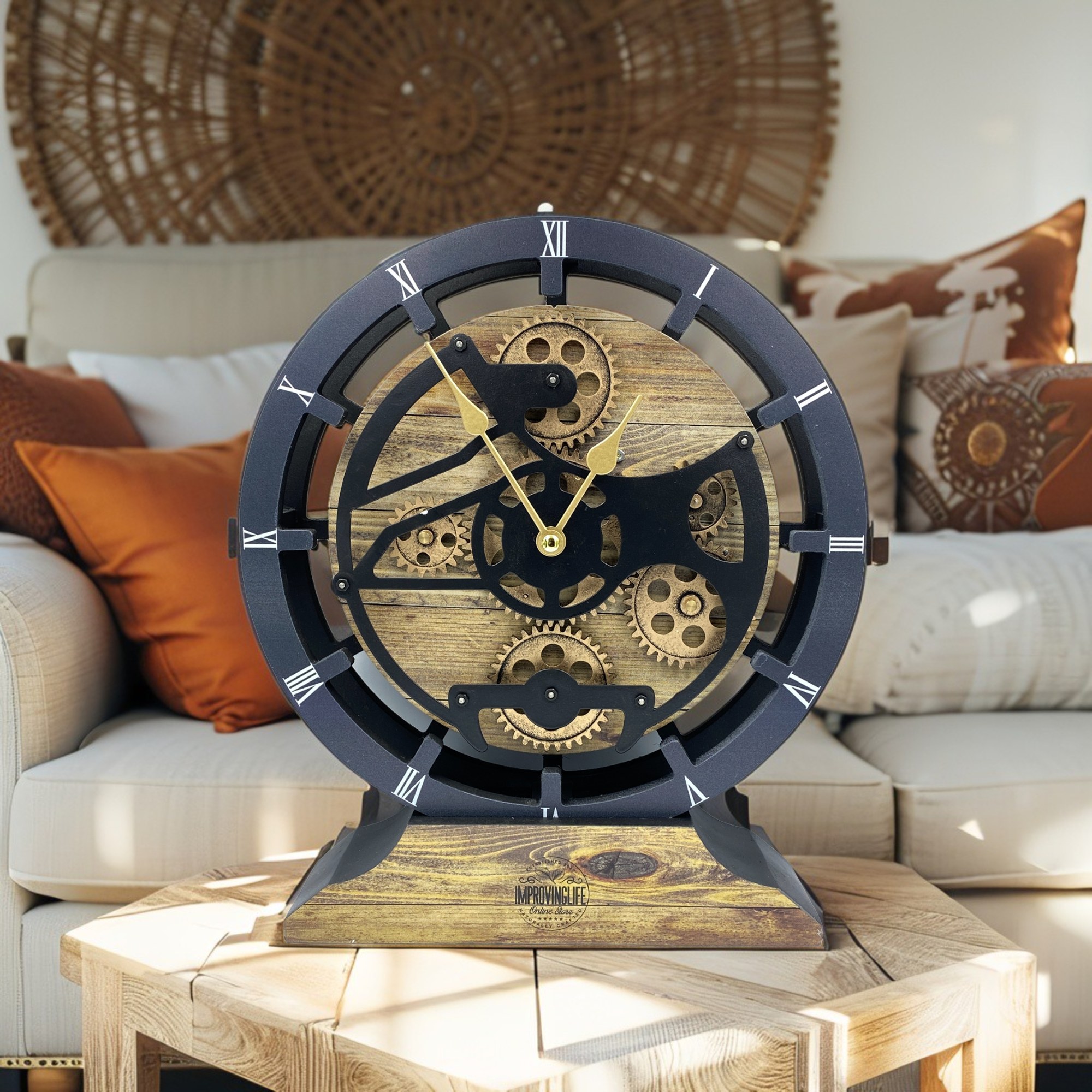
Click here to Shop the CANADA LINE DESK CLOCK ROUND (HYBRID WALL) 10 INCH GOLD ANTIQUE
Not every clock serves focus equally well. A few things to consider when choosing a workspace clock:
Size relative to viewing distance. The rough rule: add one inch of clock diameter for every foot of viewing distance. If your desk is 8 feet from the nearest wall, a 10-inch desk clock is right for close-range reading, but you'll want something larger on the far wall. A 24-inch piece like the Italy Line Wall Clock Square 24 Inch Atrani — inspired by the Amalfi Coast tile tradition and featuring a real moving-gear mechanism — is legible from across a mid-sized room without any conscious effort. A 36-inch piece like the Italy Line Wall Clock Square 36 Inch Furore or the Italy Line Wall Clock Round 36 Inch Vietri is the right choice for larger open-plan spaces, studios, or any room where your desk sits more than 12 feet from the wall.
Noise. A ticking clock in a quiet office is a focus killer for some people. Moving-gear wall clocks from The Gears Clock use a quartz movement that drives the gear mechanism — the gears themselves move silently, and the movement produces no audible tick. This is a genuine distinction worth knowing: you get all the visual presence of a mechanical-looking clock with none of the auditory intrusion.
Placement. Hang your workspace clock in your natural resting sightline — the direction your eyes go when you look up from your screen. For most desk setups, this is directly ahead or slightly to one side. Avoid placing it behind you (you'll have to turn around to read it) or directly above your monitor (you'll crane your neck). The goal is zero-effort readability.
The Ritual Effect: Why Analog Clocks Change How You Feel About Time

Click here to Shop the ITALY LINE WALL CLOCK SQUARE 24 INCH ATRANI
There is a psychological dimension to working alongside a beautiful analog clock that no productivity app can replicate, and it's worth naming honestly rather than overselling it.
When your clock is a statement piece — something with craft, weight, and visual presence — it changes your relationship to the space you work in. A room with a striking clock on the wall feels more serious, more intentional, more like a place where real work happens. That's not interior-design vanity. Environmental psychology has documented repeatedly that the design of a workspace directly influences the quality and quantity of work done in it. A cluttered, thoughtlessly assembled room produces scattered thinking. A room with considered, purposeful objects — including a clock that clearly means something — anchors your sense of being in a productive context.
The moving-gear mechanism specific to The Gears Clock pieces plays an interesting role here. The description that keeps appearing in reviews is hypnotic relaxation — the gears move slowly and steadily, and that rhythm has a quietly grounding effect. You're not staring at it. But its presence in the room registers as something calm and orderly, which is exactly the psychological register that supports sustained focus.
Time-blocking, at its best, is a practice of treating your hours as genuinely finite and genuinely valuable. A wall clock — especially one that is visually alive, precisely made, and placed where you actually work — embodies that same idea in physical form. It doesn't just tell you the time. It reminds you, every time you glance at it, that the hours are moving and this one is yours to use.
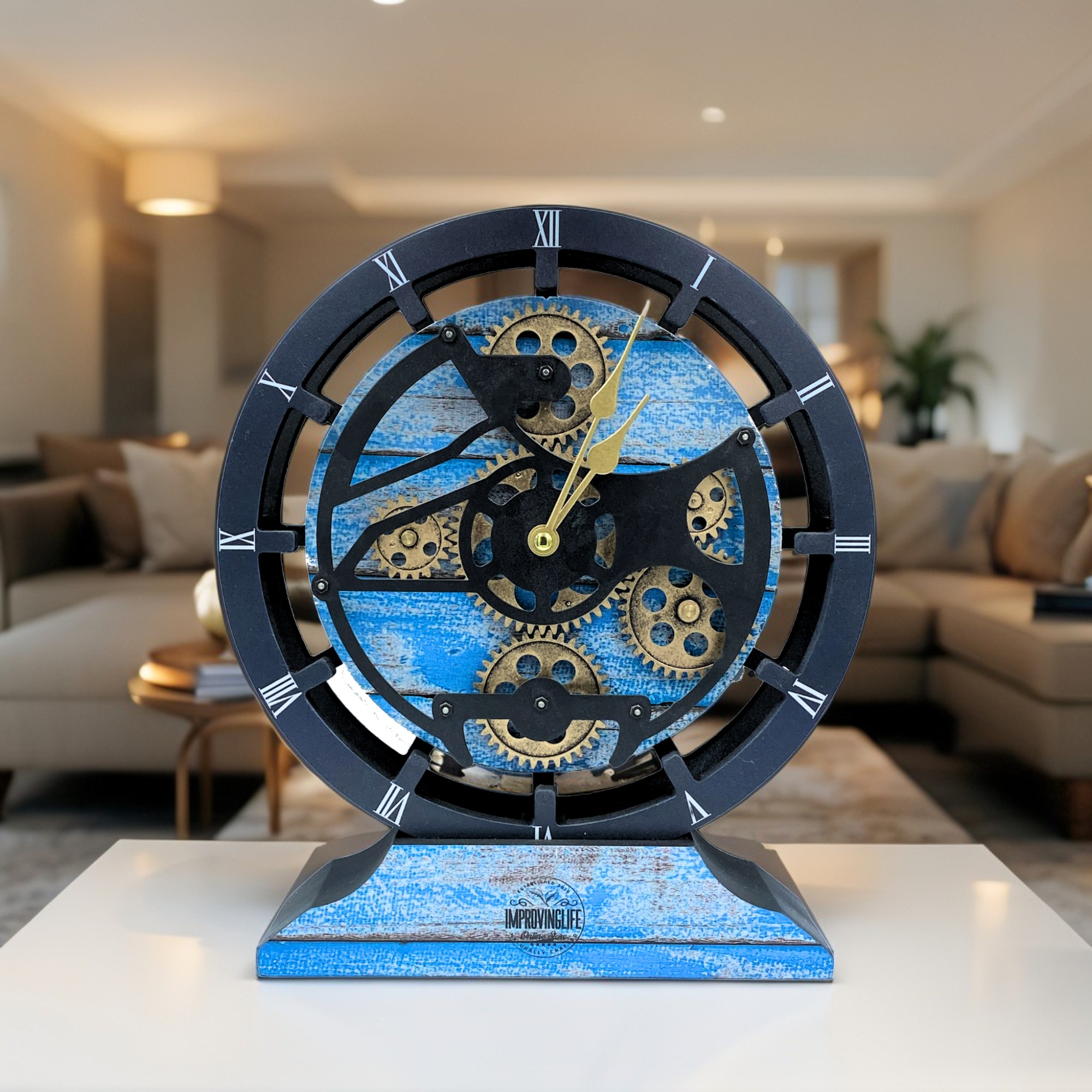
Click here to Shop the CANADA LINE DESK CLOCK ROUND (HYBRID WALL) 10 INCH OCEAN BLUE
Shop the collection: Italy 36 inch Square Clock Wall · 36 inch (60cm) Square
Keep exploring:
- How to Change the Batteries in a Moving-Gear Wall Clock (Without Losing Your Mind — or Your Settings)
- Where (and Where Not) to Hang Your Moving-Gear Wall Clock: Protecting It from Heat, Humidity, and Light
- How to Hang a Moving-Gear Wall Clock: Wall Choice, Height, and Hardware
Frequently Asked Questions
Does a ticking clock help or hurt focus?
It depends on the person and the clock. For some, a soft rhythmic tick is grounding; for others, it's distracting. Moving-gear clocks from The Gears Clock use a quartz movement that produces no audible tick — the gears turn silently — so they suit both preferences equally well.
What size clock works best for a home office or desk setup?
For close-range desk use, a 10-inch convertible piece like the Canada Line Desk Clock (available in Gold Antique or Ocean Blue) sits on your desk or mounts to the wall directly behind your monitor. For a wall across a full-size room, a 24-inch piece like the Italy Line Atrani or a 36-inch piece like the Furore or Vietri gives you effortless readability without squinting.
Can I use time-blocking if my schedule changes unpredictably every day?
Yes — the most resilient version of time-blocking doesn't schedule every task in advance. Instead, it defines two or three protected anchor blocks (for deep work) and keeps the rest flexible. The wall clock still helps: knowing at a glance that you're 30 minutes into your anchor block makes it easier to hold the boundary, even when something tries to interrupt it.


