

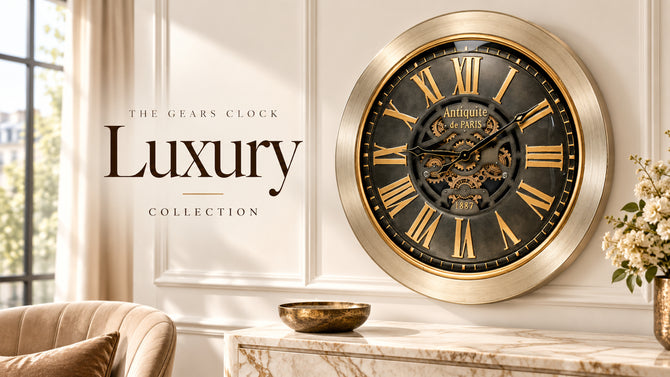










At first glance, a clock is a clock. It tells time, hangs on a wall, and quietly marks the passing of hours. Yet behind this apparent simplicity lies a profound difference in philosophy, engineering, and experience. Mechanical and quartz clocks do not just measure time in different ways. They represent two fundamentally different relationships with time itself.
Understanding the real difference between mechanical and quartz clocks means looking beyond accuracy charts and price points. It means exploring craftsmanship, longevity, design, and the emotional connection we form with the objects that live in our homes.
Two Paths in the History of Timekeeping
Mechanical clocks are the result of centuries of experimentation and refinement. Long before electricity existed, humans sought ways to divide time into predictable units. Springs, weights, pendulums, and gears became the tools through which time was captured and controlled.
Quartz clocks, by contrast, are a modern invention. Developed in the twentieth century, they reflect a technological shift toward electronics, automation, and efficiency. Instead of relying on physical motion regulated by gravity or balance, quartz clocks rely on the predictable vibration of a crystal energized by electricity.
Both systems are ingenious. But they speak different languages.
What Is a Mechanical Clock?

A mechanical clock is a machine powered by stored energy and governed by motion.
Energy is typically stored in a wound spring or a suspended weight. This energy is released gradually through a carefully designed system of gears. At the center of this system is a regulator, often a pendulum or balance wheel, which oscillates at a constant rate. Each oscillation allows a controlled amount of energy to pass through the gear train.
Gears then translate this controlled release into visible motion. The second hand advances. The minute hand completes its rotation. The hour hand moves almost imperceptibly.
Nothing is digital. Nothing is abstract. Every moment you see is physically created.
This is why so many people are drawn to mechanical wall clocks with real moving gears. They do not simply show time. They show time being made.
If you’re curious to see how these mechanical principles take shape in real design pieces, you can explore our collection of wall clocks with real moving gears, where engineering and aesthetics meet.
What Is a Quartz Clock?

A quartz clock measures time through electronics rather than mechanics.
Inside the clock, a battery sends an electric current through a tiny quartz crystal. When energized, the crystal vibrates at a highly stable frequency. An electronic circuit counts these vibrations and converts them into regular pulses. These pulses drive a small motor that moves the hands or updates a digital display.
Quartz clocks are marvels of efficiency. They are compact, inexpensive to produce, and extremely accurate. For many practical applications, they are ideal.
However, the process remains invisible. The timekeeping happens inside a sealed circuit, removed from physical interaction.
Accuracy: Precision vs Perception

From a purely technical standpoint, quartz clocks are more accurate. They typically lose or gain only a few seconds per month. Mechanical clocks, depending on design and environment, may vary slightly more.
But accuracy is not the whole story.
Mechanical clocks introduce a different kind of precision. Not numerical perfection, but rhythmic consistency. The gentle oscillation of a pendulum or balance wheel creates a steady cadence that many people find reassuring rather than flawed.
In living spaces, this difference matters. Absolute precision is rarely essential. Atmosphere often is.
Movement, Sound, and Presence
Mechanical clocks have presence.
The slow movement of gears, the continuous sweep of the hands, and sometimes the faint sound of motion add a layer of life to a room. These clocks feel active, even when no one is looking at them.
Quartz clocks are quieter and more uniform. Their ticking is often sharp and regular. In some environments, this neutrality is desirable. In others, it can feel sterile or disconnected.
The distinction is subtle but powerful. One system feels organic. The other feels utilitarian.
Design Possibilities and Visual Depth
Design is one of the most significant differences between mechanical and quartz clocks.

Mechanical clocks often embrace their complexity. Exposed gears, layered components, and visible motion become part of the aesthetic. Depth, shadow, and reflection change throughout the day, making the clock feel dynamic.
Quartz clocks usually hide their internal workings. The design focus is placed on the dial, numerals, or casing. While this can be elegant, it rarely offers the same sense of visual storytelling.
This is why interior designers often favor statement gear wall clocks as focal points. They combine function, movement, and sculptural presence in a single object.
To see how mechanical timekeeping becomes part of a living space, you can take a look at our wall clocks designed to turn time into a visual experience.
Longevity and Sustainability
Quartz clocks rely on electronic components. Over time, circuits degrade, parts become obsolete, and repairs are often impractical. Replacement is usually cheaper than restoration.
Mechanical clocks are built differently. They are designed to be maintained. Gears can be cleaned, lubricated, and adjusted. Springs can be replaced. With proper care, a mechanical clock can function for decades or even generations.
This longevity changes the relationship between owner and object. Mechanical clocks feel permanent. Quartz clocks often feel disposable.
Maintenance as a Relationship
Quartz clocks require little attention. Changing a battery is usually enough.
Mechanical clocks require occasional care. They benefit from cleaning, proper placement, and periodic adjustment. While this may sound inconvenient, many owners see it as part of the experience.
Maintaining a mechanical clock reinforces the idea that it is an instrument, not a gadget. It encourages respect and awareness.
Emotional Value and Craftsmanship
Mechanical clocks carry emotional weight.
They represent human ingenuity, patience, and craftsmanship. You can see how they work. You can understand the logic of their motion. This transparency creates trust and admiration.
Quartz clocks prioritize convenience and consistency. Mechanical clocks prioritize experience and meaning.
Neither approach is inherently superior. But they fulfill different emotional needs.
Choosing the Right Clock for Your Space
The choice between mechanical and quartz depends on context.
Quartz clocks are ideal where accuracy, affordability, and simplicity are priorities. Offices, kitchens, and utility spaces often benefit from their efficiency.
Mechanical clocks shine in living rooms, studies, and spaces where design and atmosphere matter. Their presence adds character. Their motion adds life.
The right choice is the one that aligns with how you want a space to feel.
Mechanical Time in a Digital World

In a world dominated by screens, notifications, and digital precision, mechanical clocks offer something rare.
They slow time down. They make it visible. They remind us that time is not just data flowing invisibly through circuits. It is motion, interaction, and rhythm.
This is why mechanical clocks continue to hold value even in an age of atomic accuracy.
Final Reflection

Mechanical and quartz clocks do not simply measure time differently. They represent two ways of experiencing it.
Quartz clocks tell time efficiently and invisibly. Mechanical clocks show time being created, moment by moment, through motion and balance.
In choosing between them, we are not just choosing a device. We are choosing how we want time to exist in our lives.
And sometimes, watching gears turn is more meaningful than knowing the exact second.


