

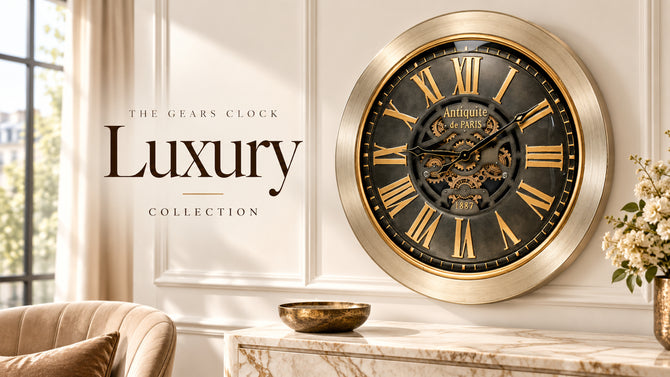










You glance at your phone to check the time. Forty-five seconds later you're reading a text, skimming a notification, and then — almost without deciding to — you're scrolling. The work you were doing sits open on your desk, cooling like an untouched cup of coffee. Sound familiar? That tiny moment of friction costs more than you think.
We've become conditioned to treat our phones as the default answer to every small question, including "what time is it?" But that single habit — reaching for a screen every time you want to check the hour — is quietly fragmenting your focus, dozens of times a day. There's a better way, and it's been hanging on walls for centuries.
The Hidden Cost of Phone-Checking

Click here to Shop the ENGLAND LINE WALL CLOCK ROUND 36 INCH AQUA GREEN
Research from the University of California Irvine found that it takes an average of 23 minutes to fully regain deep focus after an interruption. A phone notification — even one you consciously ignore — still registers in your peripheral awareness and pulls at your attention. Now consider how often you pick up your phone just to check the time, only to be sideswiped by whatever else is waiting on that screen.
The problem isn't willpower. It's design. Smartphones are engineered by some of the sharpest behavioral scientists on the planet to keep you engaged. Every unlock is a tiny gamble: what's there? That unpredictability triggers a small dopamine response, and your brain starts to crave the loop. Checking the time becomes the excuse; the phone is the trap.
A wall clock offers no such trap. It tells you the time. That's it. You look up, you register the hour and minute, you look back down. The interruption is measured in seconds, not minutes — and it leaves your mental thread completely intact.
Time Awareness vs. Time Anxiety

Click here to Shop the CANADA LINE DESK CLOCK SQUARE (HYBRID WALL) 10 INCH VINTAGE BROWN
There's a meaningful difference between knowing what time it is and constantly checking what time it is. Deep workers — the writers, designers, developers, and strategists who consistently produce their best work — tend to share one habit: they maintain a gentle, ambient awareness of time without obsessing over it.
An analog clock on your wall supports exactly this. Because the face is always visible in your peripheral field, your brain passively registers the passage of time without requiring a conscious action. The position of the hands gives you an almost felt sense of where you are in the day — the way the light through a window tells you it's mid-afternoon before you've even thought about it. This is time awareness, and it's deeply different from the brittle, interruption-driven time anxiety that phone-checking creates.
Digital clocks — whether on a phone or a microwave — display a number. Analog clocks display a relationship. The sweep of the minute hand toward the hour, the arc of the morning curving into afternoon: these visual cues engage the part of your brain that thinks spatially and contextually, making the passage of time feel comprehensible rather than abstract.
Building Routines Around a Fixed Anchor

Click here to Shop the FINLAND LINE WALL CLOCK OVAL 26 INCH "ESPOO" WOOD-BLACK
Time-blocking is one of the most consistently recommended productivity strategies — the practice of assigning specific windows of your day to specific types of work. It sounds simple, but it requires one thing most people underestimate: a reliable, low-friction way to track your blocks.
A wall clock is a fixed, shared, always-on reference point. It doesn't need to be unlocked. It doesn't change its face when you look at it. And because it exists in your physical space rather than inside a device, it connects your sense of time to your environment rather than to the digital world.
- Morning deep work block: Glance at the clock to know you have until 11 a.m. — no need to set a phone timer that might buzz and startle you.
- Afternoon transitions: A visible clock lets you wind down a task naturally as the hands approach your next block, instead of being abruptly notified.
- End-of-day boundaries: When the hands reach your chosen stopping point, you stop. The clock makes that agreement with yourself visible and concrete.
There's also a psychological dimension here. A wall clock in your workspace signals — to you and to anyone who shares the space — that time is being taken seriously. It sets a tone. Studies on environmental design consistently show that the objects around us shape our behavior in ways we rarely notice consciously. A beautiful, well-placed clock is a quiet statement: this is a place where time matters.
Choosing the Right Clock for Your Workspace

Click here to Shop the ENGLAND LINE WALL CLOCK ROUND 36 INCH SILVER GREY
Not all wall clocks are equally suited to focused work. For a home office or studio, a few qualities matter more than aesthetics alone:
- Legibility at a glance: You should be able to read the time in under a second from your working position. Clear contrast between hands and dial face, and a sensible scale for the room, make this effortless.
- A silent movement: Tick-tock sounds can be grounding for some people and maddeningly distracting for others. If you work in silence or on video calls, look for a clock with a sweep (continuous) movement rather than a step movement — it runs without the click.
- Placement at eye level or just above: A clock you have to crane your neck to see will go ignored. Position it so that a natural glance — barely a movement of the head — lands on the face.
The size matters too. In a compact home office, a 10–12 inch clock at roughly eye level when seated is usually ideal. In a larger open studio or shared workspace, something in the 14–18 inch range commands the wall without demanding attention — it simply exists, available whenever you need it.
The Simplest Productivity Upgrade You Haven't Made Yet

Click here to Shop the ENGLAND LINE WALL CLOCK ROUND 36 INCH WOOD & STONE
Productivity culture tends to chase complexity: the right app, the perfect system, the optimal notification schedule. But the most effective interventions are often the ones that remove friction rather than adding more layers to manage.
Putting a quality analog clock on the wall of your workspace is one of the simplest, most durable upgrades you can make to your environment. It costs you nothing in maintenance, nothing in attention — and it gives back something quietly precious: the ability to know what time it is without sacrificing the thread of what you were thinking.
At The Gears Clock, every piece we design is built to live on the wall and earn its place there — not just as an object worth looking at, but as a presence that makes the room work better. Whether you're furnishing a home office, a studio, or a corner of the living room where you do your best thinking, there's a clock that belongs there. Browse the collection at thegearsclock.com and find the one that fits the way you work.


