












There is a particular kind of decorating mistake that happens most often in small spaces: going too safe. A tiny clock hung in a narrow hallway, a postage-stamp-sized piece on a wide entryway wall — these choices don't make a small room feel larger. They make it feel unfinished. Getting the scale right in compact spaces is actually one of the most high-stakes decorating decisions you'll make, because in a small room, every element is visible at close range and every proportion is immediately felt.
This guide is specifically for the rooms that decorators and buyers most often get wrong: entryways, hallways, home corridors, compact dining nooks, and small bedrooms. We'll walk through how to measure, how to choose between statement sizing and understated sizing, and which clocks from The Gears Clock line are genuinely suited to these spaces — and which ones aren't.
Why Scale Rules Everything in a Small or Narrow Space
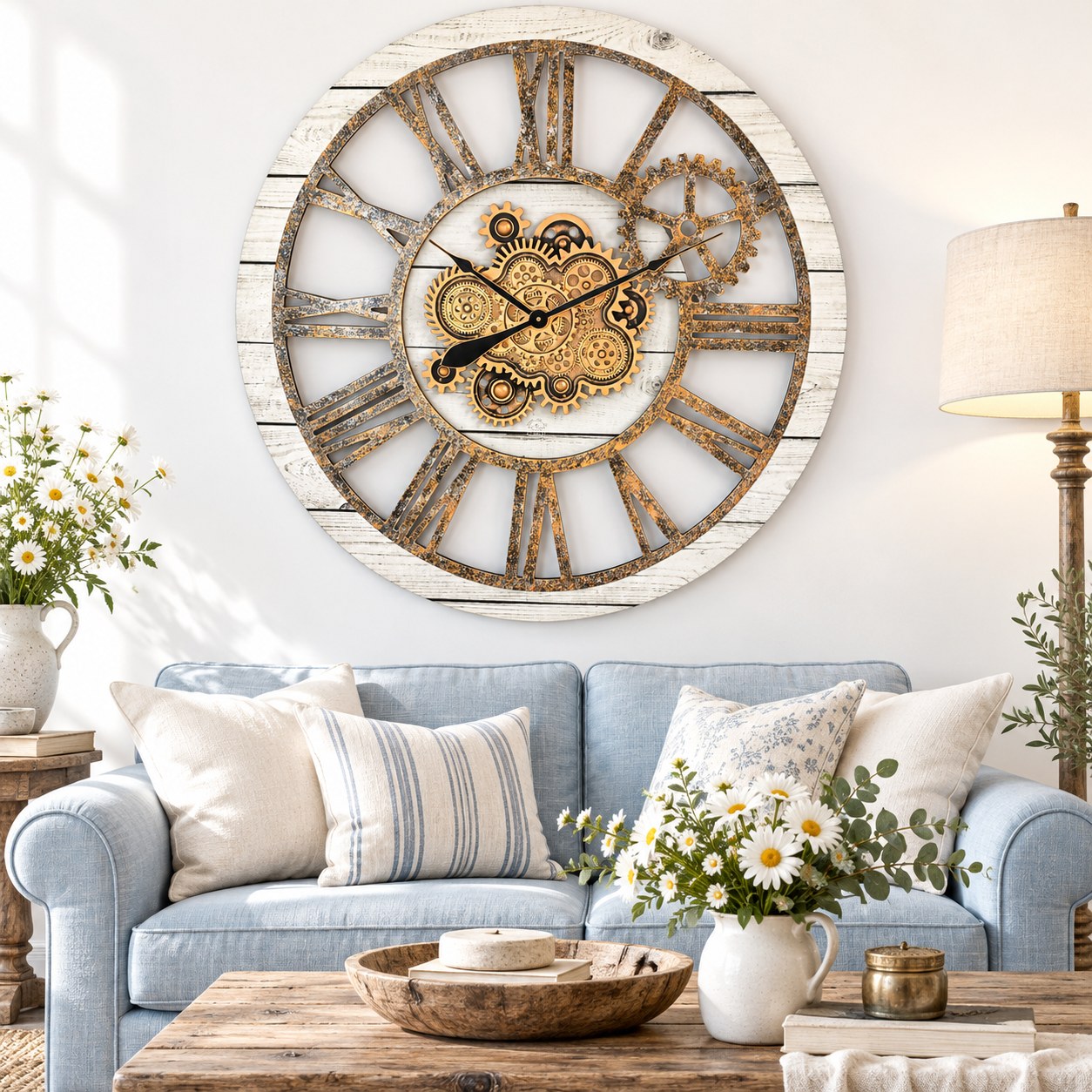
Click here to Shop the AMERICA LINE WALL CLOCK ROUND 36 INCH WHITE FARMHOUSE
In a large living room, a clock that's slightly too small reads as a minor misstep. In an entryway that's 4 feet wide, the same clock reads as an afterthought. This is because small spaces concentrate your eye — there's nowhere else to look. Whatever you hang on the wall in a compact room becomes the focal point by default, not by choice.
The conventional wisdom is to "go small in small rooms." That advice is wrong more often than it's right. What actually works is filling the visual field appropriately. Interior designers use a simple rule: a wall hanging should occupy between 60 and 75 percent of the usable wall width above any furniture, or between 50 and 65 percent of an empty wall section. In a hallway with a 30-inch-wide wall panel between two doorframes, that means a clock spanning 15 to 20 inches works well. On the broader end of an entryway — say, a wall that runs 48 inches before a corner — you can go considerably larger without the room feeling cluttered.
There's another factor that matters especially with moving-gear clocks: proximity. In a hallway, you walk past the clock at 18 inches, not 8 feet. That changes everything. The detail work in the dial, the gear movement, the texture of the finish — all of it is experienced up close. This is actually an argument for a more intricate, visually layered clock in a compact space, because the craftsmanship will be seen and appreciated in ways it never would be across a living room.
The 10-Inch Desk-to-Wall Hybrid: A Genuinely Useful Tool for Tight Spots

Click here to Shop the CANADA LINE DESK CLOCK SQUARE (HYBRID WALL) 10 INCH GREY & WHITE
Not every small space has a wall section long enough to anchor even a 24-inch clock. Sometimes the honest answer is that a surface clock — or a convertible clock that works both ways — is the right call.
The Canada Line Desk Clock Square 10 Inch Grey & White is worth knowing about precisely because of its dual identity. It ships with a detachable base that lets you stand it on a console table, an entryway credenza, or a floating shelf — but remove that base and it mounts flush to the wall like any traditional wall clock. That 10-inch square format fits into spaces that can't accommodate a 24-inch round without feeling visually crowded: a narrow hallway shelf, a small bathroom vanity wall, or the side wall of a galley kitchen.
At 10 inches, the Canada Line's real moving gear is experienced at close range, which suits an entryway perfectly. Someone arriving home pauses at a console table, sets down their keys, and watches the gears turn for a moment. That's not incidental — it's the point. The Grey & White colorway also reads cleanly in transitional spaces that connect rooms with different palettes, since it neither competes with warm tones nor clashes with cool ones.
That said, 10 inches is genuinely small on a wall. If you have more than about 24 inches of clear wall to work with, you will want to step up in size — the 10-inch format will look undersized and lose the visual authority that makes it worth having in the first place.
When a 24-Inch Clock Is the Sweet Spot — and When It Isn't

Click here to Shop the AMERICA LINE WALL CLOCK SQUARE 24 INCH WOOD AND STONE
The 24-inch format is the most versatile size in the moving-gear clock category, and it's where most compact-room decisions land correctly. It's large enough to anchor a wall visually, small enough to work in rooms where a 36-inch clock would overwhelm the space, and available in both round and square profiles — which matters more than most buyers realize.
Consider the America Line Wall Clock Square 24 Inch Wood and Stone. The square format reads differently on a wall than a round clock the same diameter. A 24-inch square clock presents a wider visual footprint — its flat edges align naturally with doorframes, shelving units, and architectural lines in a way that a round clock doesn't. In a hallway with strong vertical molding or a grid-panel wall treatment, the square format feels intentional and architectural rather than decorative. The Wood and Stone finish — warm wood tones layered against a stone-look dial — also works exceptionally well in entryways because it bridges rustic and contemporary without committing fully to either.
Where the 24-inch format stops working is in a genuinely cramped corridor — a passageway that's under 30 inches wide where the clock would be seen almost directly head-on from less than a foot away. In that case, either step down to the 10-inch convertible or reconsider the wall entirely and use a surface placement instead. A clock that's physically too large for its setting creates the opposite of what you want: instead of anchoring the space, it makes the room feel smaller.
Going Bold: When a 36-Inch Clock Works in a Compact Room
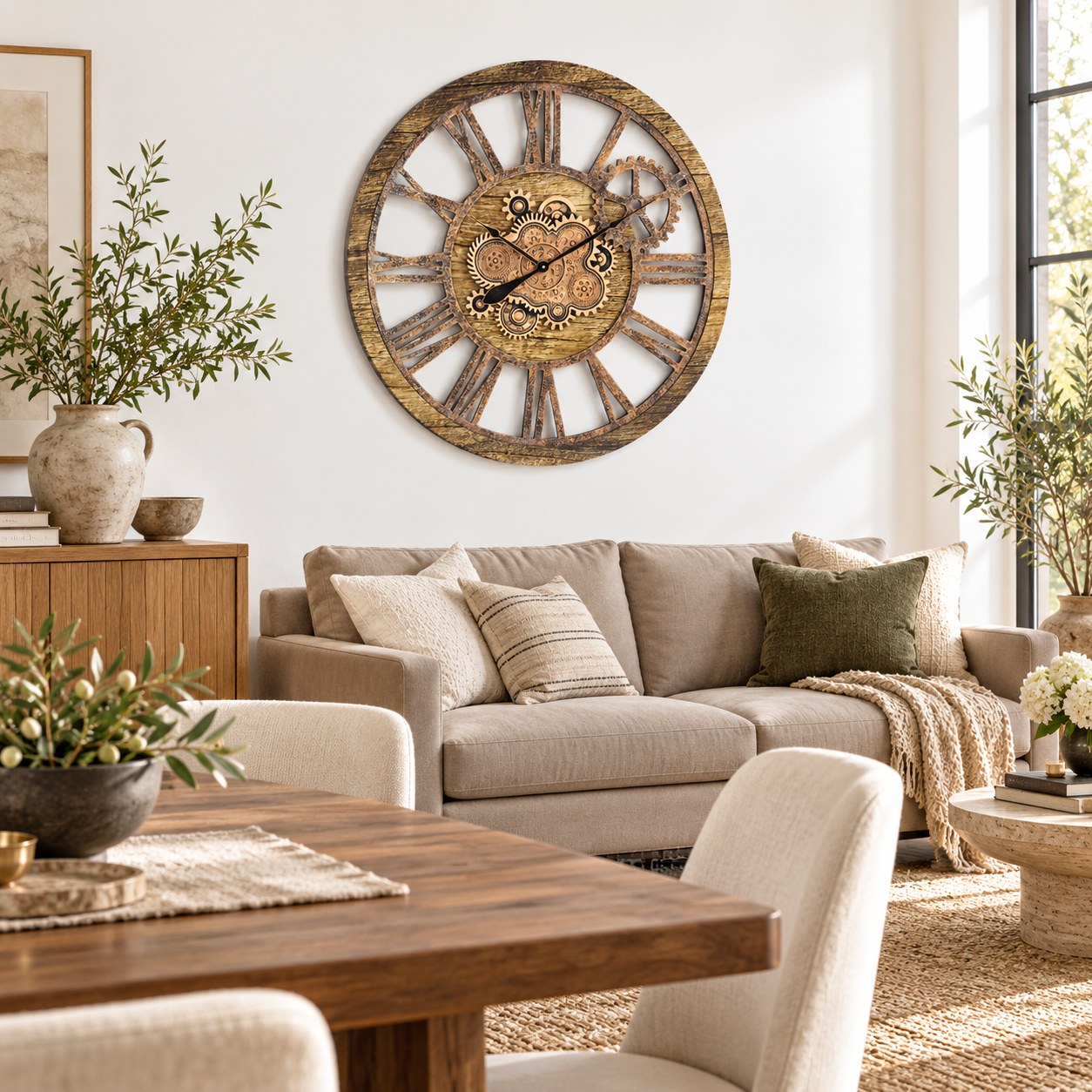
Click here to Shop the AMERICA LINE WALL CLOCK ROUND 36 INCH GOLD ANTIQUE
This may seem counterintuitive, but a 36-inch statement clock can work brilliantly in certain small spaces — specifically, when the room has only one real wall to work with and when the viewing distance is at least 6 to 8 feet, even if the room itself is compact. A small dining nook, for example, may have only 80 square feet of floor space but a clear sightline of 10 feet across the table. A 36-inch clock on that far wall will anchor the room without overwhelming it, because scale is about proportion to the wall, not to the floor plan.
The America Line 36-inch round clocks offer several finishes worth considering for this scenario. The America Line Wall Clock Round 36 Inch White Farmhouse is particularly effective in compact rooms with low ceilings, because its white palette keeps the wall feeling open and airy while the 36-inch diameter still makes the kind of visual statement the room needs. White-on-white reduces visual weight even as the physical size remains large — a useful optical trick in rooms where you can't afford to make the walls feel heavier than they are.
For small spaces with higher ceilings or more dramatic finishes — an entryway with dark wallpaper, a moody powder room, a small library or study — the America Line Wall Clock Round 36 Inch Gold Antique or the America Line Wall Clock Round 36 Inch Vintage Brown bring a richness that actually benefits from the intimacy of a small space. In a large living room, those finishes are handsome. In a compact room viewed from close quarters, they're extraordinary. The patina, the aged texture, the warm tonal depth — all of it reads at a level of detail that a wide-open room simply doesn't allow.
One important caution: at 36 inches (90 cm) across, these clocks need a wall section at least 48 inches wide to breathe properly. Don't hang a 36-inch round clock with less than 6 inches of clearance on each side — it will read as crammed rather than bold.
Practical Installation Considerations Specific to Small Spaces
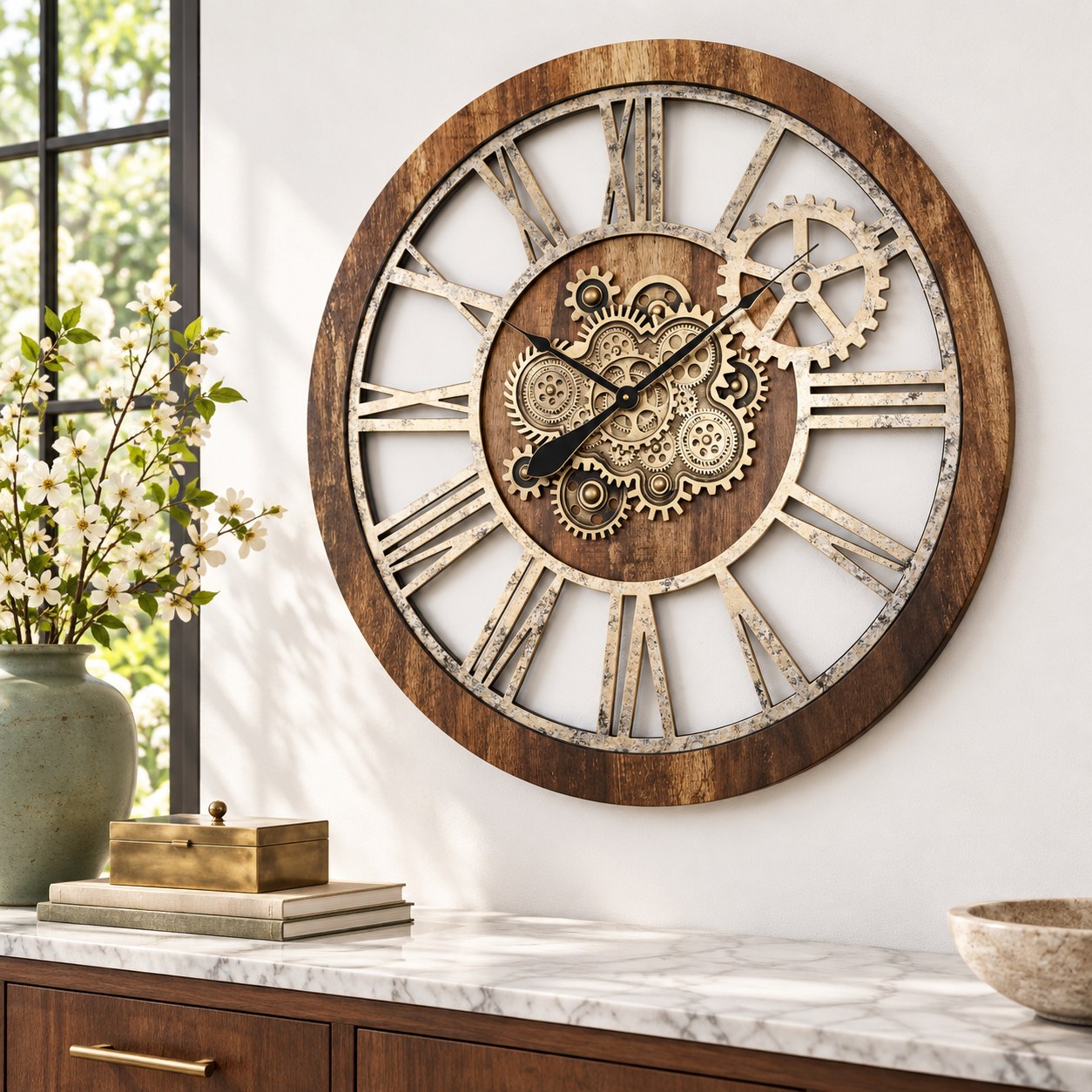
Click here to Shop the AMERICA LINE WALL CLOCK ROUND 36 INCH VINTAGE BROWN
Hanging height is recalibrated in small spaces. The standard advice — eye level at roughly 57 to 60 inches from the floor — applies when you're viewing a clock from across a room. In a hallway or entryway, you're often moving past the clock rather than standing still in front of it, which means hanging it slightly higher (62 to 66 inches to center) can actually improve the experience. At that height, it's visible as you approach from down the hall and doesn't require you to stop and look down or around furniture to read it.
In a compact room where the clock is positioned above a console table or entry bench, standard furniture clearance applies: leave at least 6 to 8 inches between the top of the furniture and the bottom of the clock. For a 24-inch clock centered above a 32-inch-tall console, that means the clock's center point lands around 52 inches from the floor — slightly lower than typical, which works fine given close viewing distance.
Moving-gear clocks require a reliable power source regardless of size. Even the 10-inch Canada Line desk/wall hybrid runs on batteries, which matters in hallways and entryways where there's rarely an outlet on the wall. Battery operation means zero cable management issues — a genuine practical advantage in corridors where running a cord would be both unsightly and a tripping hazard. When shopping, confirm the battery specification for the specific model you're buying, and always keep a spare set stored nearby, since a hallway clock that stops is one of the first things guests and family notice.
Finally, consider the noise question. Entryways and hallways are transitional spaces — people pass through rather than inhabiting them — so the gentle, rhythmic motion of a moving-gear clock is typically heard only in passing. But if your hallway connects directly to a bedroom or a home office where silence matters, choose a quartz movement clock specifically described as silent or near-silent. The Gears Clock moving-gear mechanism is designed to be quiet rather than ticking loudly, which makes it well-suited for placement near sleeping or working areas.
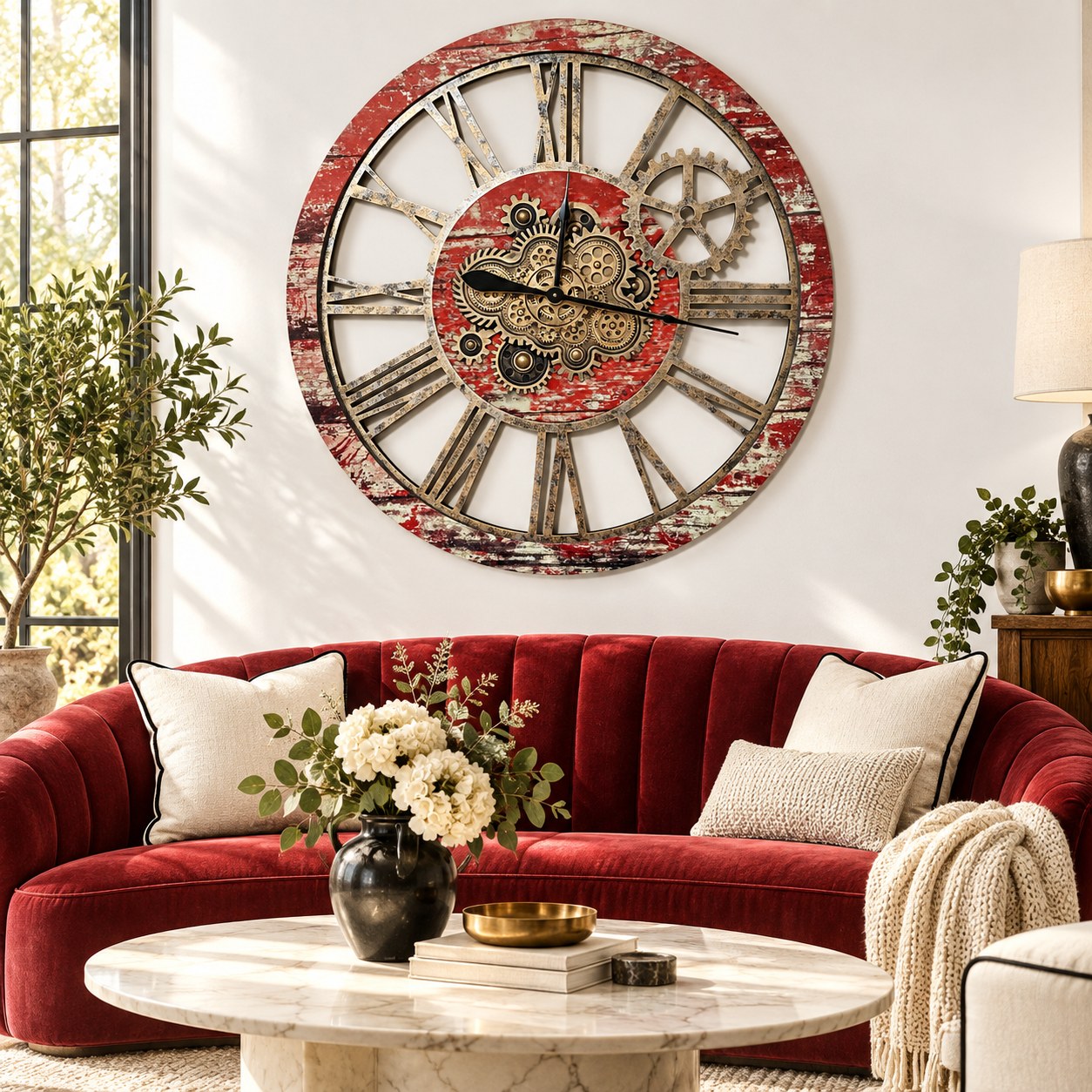
Click here to Shop the AMERICA LINE WALL CLOCK ROUND 36 INCH RED LAVA
Shop the collection: 36 in - 90 cm · Wall Clock
Keep exploring:
- The Best Moving-Gear Wall Clock for Every Housewarming Gift — From First Apartments to Forever Homes
- Why Your Brain Needs a Clock on the Wall (Not a Phone in Your Hand)
- High Ceilings, Big Walls: How to Choose the Right Wall Clock for a Grand Living Room
Frequently Asked Questions
What's the minimum wall width I need for a 36-inch wall clock to look right?
You ideally want at least 48 inches of clear wall — that gives you roughly 6 inches of breathing room on each side of the 36-inch (90 cm) diameter. In a space narrower than that, a 24-inch clock will hold the wall better without feeling wedged in.
Can the Canada Line 10-inch clock really function as a wall clock, or is it mainly a desk piece?
It's genuinely convertible — the base detaches cleanly and the clock mounts directly to the wall just like a standard wall clock. For small walls, shelving niches, or tight bathroom walls, the wall-mounted version works well. The desk configuration is best when you have a surface that places the clock at close-to-eye-level height naturally, like a tall console or a floating shelf.
Should I match the clock finish to my entryway's existing hardware and fixtures?
Matching exactly tends to look coordinated but flat. A better approach is to complement rather than match — if your entryway hardware is brushed brass, the Gold Antique finish on the America Line 36-inch round will harmonize without being identical. If your fixtures are matte black, the Grey & White finishes in the Canada or England Lines provide contrast that reads intentional rather than mismatched.


