












The first time most people see a moving-gear wall clock, they stop mid-sentence. There's something almost magnetic about watching real, physical gears rotate — not an animation, not a screen effect, but actual machined metal turning in sequence on your wall. A common follow-up question is always some version of: "How does that actually work? And why isn't it loud?"
These are fair questions, and the answers are genuinely interesting. Understanding the mechanism behind a moving-gear clock won't make you enjoy it any less — it'll make you appreciate the engineering more every time you glance at it. This article breaks it down clearly, from the quartz heartbeat at the center all the way out to the outermost gear ring spinning on your wall.
The Quartz Heartbeat: Where All Motion Begins
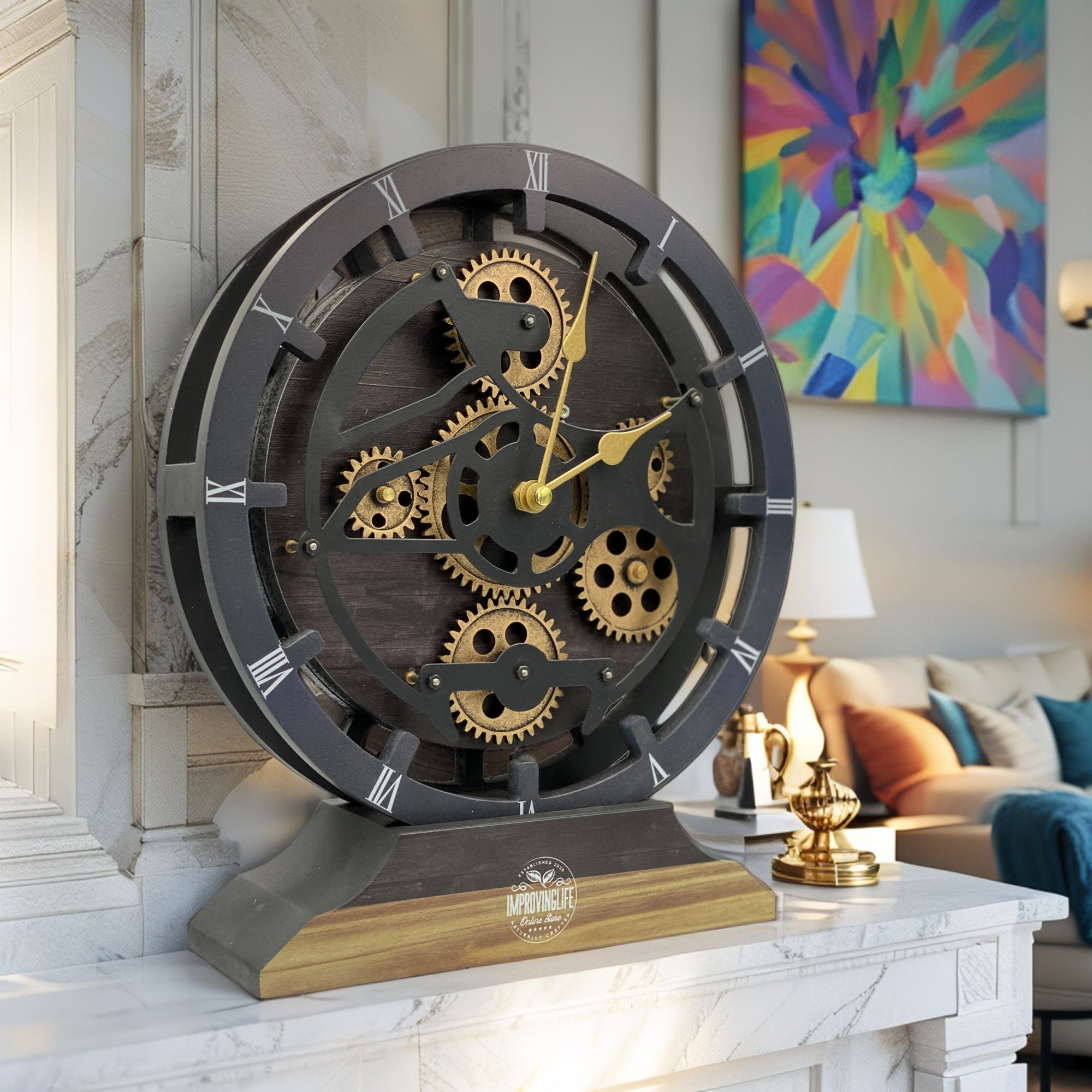
Click here to Shop the CANADA LINE DESK CLOCK ROUND (HYBRID WALL) 10 INCH VINTAGE BLACK
Every moving-gear clock from The Gears Clock starts with the same humble component hiding behind the face: a quartz crystal oscillator. When a small electrical current passes through a sliver of quartz crystal, it vibrates at an extraordinarily consistent frequency — exactly 32,768 times per second. That number isn't arbitrary. It's 2 to the power of 15, which means a simple digital circuit can divide it down by half, repeatedly, until you arrive at exactly one pulse per second.
That one-pulse-per-second signal is what drives everything else. A small stepping motor inside the quartz movement converts each electrical pulse into a tiny mechanical rotation — a fraction of a turn — which feeds into a gear train. So the "life" you see in the decorative gear rings on the clock face isn't a separate motor running independently; it all traces back to this single crystal vibrating tens of thousands of times every second.
This is why quartz-driven moving-gear clocks are so accurate. The crystal doesn't drift with temperature or humidity the way a purely mechanical pendulum does. It keeps time to within a few seconds per month under normal conditions — reliable timekeeping dressed up in something that looks like it belongs in a Victorian inventor's workshop.
The Gear Train: Translating Pulses into Visible Motion
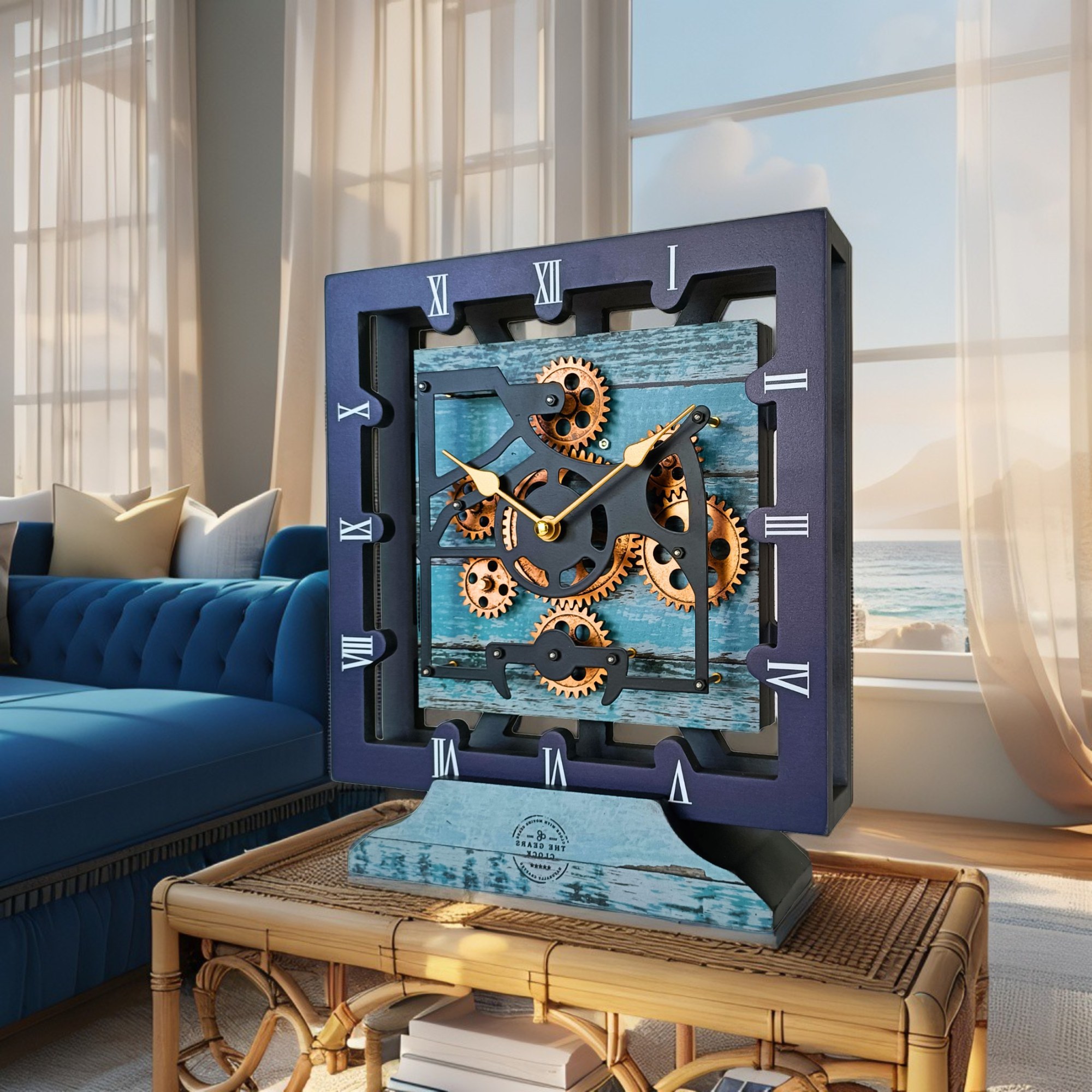
Click here to Shop the CANADA LINE DESK CLOCK SQUARE (HYBRID WALL) 10 INCH AQUA GREEN
Here's where things get visually satisfying. A gear train is a series of interlocking toothed wheels, each one driving the next at a different speed determined by the ratio of their tooth counts. In a conventional clock, this gear train is tucked entirely behind the dial, invisible. In a moving-gear clock, portions of it are deliberately exposed and made decorative — the gears you see spinning are functional parts of the timekeeping mechanism, not cosmetic additions bolted on for effect.
The classic arrangement works like a reduction system. The fastest-spinning gear near the movement rotates quickly but does relatively little visible work. Each successive gear in the chain turns more slowly and — in an exposed design — becomes larger and more visually dominant. By the time motion reaches the outermost ring of a large clock, it's moving slowly enough to feel meditative rather than frenetic. Watch closely for a minute and you'll see it. Look away for ten minutes and you'll notice it has clearly moved. That pacing is by design.
In smaller convertible pieces like the Canada Line Desk Clock Square in Wood & Stone (10-inch) or the Canada Line Desk Clock Square in Vintage Black (10-inch), the gear train is compressed into a compact 10-inch frame — about 25 cm across — yet the same mechanical logic applies. The movement at center drives a sequence of gears outward, creating motion that fills the face completely. The engineering challenge at smaller scale is achieving the same visual sense of layered depth that a larger wall clock delivers with more physical room to work with. The craftsmen at The Gears Clock solve this through careful gear sizing and dial layout, ensuring even the 10-inch models have genuine visual movement rather than a single token spinning disc.
Why Moving Gears Are Quiet — and What "Quiet" Really Means

Click here to Shop the CANADA LINE MANTEL CLOCK ROUND (HYBRID WALL) 16 INCH SILVER GREY
This is the question people ask most often before purchasing, and it deserves a direct answer. The stepping motor inside a quartz movement produces a very faint tick — not the loud mechanical tick of a balance-wheel clock, but a soft click as the motor advances one step per second. In a quiet bedroom at 2 a.m., you might hear it if you press your ear close. From a normal sitting or standing distance of a few feet, the sound is effectively inaudible in any room with ordinary ambient noise — a gentle hum of ventilation, soft background music, conversation.
The decorative gears themselves add almost nothing to that sound. They're not under spring tension the way gears in a mechanical watch are; they rotate smoothly, driven by the movement, without any of the clicking, whirring, or escapement sounds associated with traditional mechanical timepieces. The result is what The Gears Clock describes as a "quiet quartz movement" — a term you'll see used for the Sweden Line "Stockholm" 22-inch wall clock in Leather Brown-Gold, which uses high-grade components specifically selected for that characteristic. The Stockholm's brushed-silver bezel and glass cover also help dampen any residual sound from the movement behind the dial.
The practical implication: moving-gear clocks are genuinely suitable for bedrooms, home offices, and libraries — anywhere tick noise would be a problem. The motion is present; the noise largely isn't.
Two Battery Circuits: Hands and Gears (and Why They're Sometimes Separate)

Click here to Shop the SWEDEN LINE WALL CLOCK ROUND 22 INCH "STOCKHOLM" LEATHER BROWN-GOLD
One thing that surprises many new owners is discovering their moving-gear clock has more than one battery compartment. This isn't an oversight or a design quirk — it reflects a deliberate engineering choice rooted in power consumption.
The hands of the clock and the decorative gear display often draw power differently. The timekeeping movement (which drives the hands) needs only a tiny, steady trickle of current — a single AA or AAA battery can run it for a year or more. The illuminated or motor-assisted gear display, however, may have slightly different power requirements depending on the model. Running both functions from a single battery cell could mean compromising either the accuracy of the timekeeping or the longevity of the gear display's operation. Giving each its own dedicated power source allows both to perform optimally and independently.
In practical terms, this means the two battery sets may not run down at exactly the same rate. You might find yourself replacing one before the other. This is normal and expected. For the Canada Line Mantel Clock Round (16-inch) in Silver Grey — a 40 cm convertible mantel/wall piece — keeping track of which compartment powers the movement versus the gear display is worth noting when you first install the batteries, so a future swap is straightforward. Labeling the compartments lightly with a pencil on first installation is a simple habit that saves confusion later.
When you do replace batteries, you may notice the gears briefly continue or stop independently of the hands, depending on which compartment you've changed. This is entirely normal. Both circuits operate on their own logic and will re-synchronize to steady operation within a minute or two of fresh batteries being seated correctly.
Convertible Clocks: The Same Mechanism, Two Lives
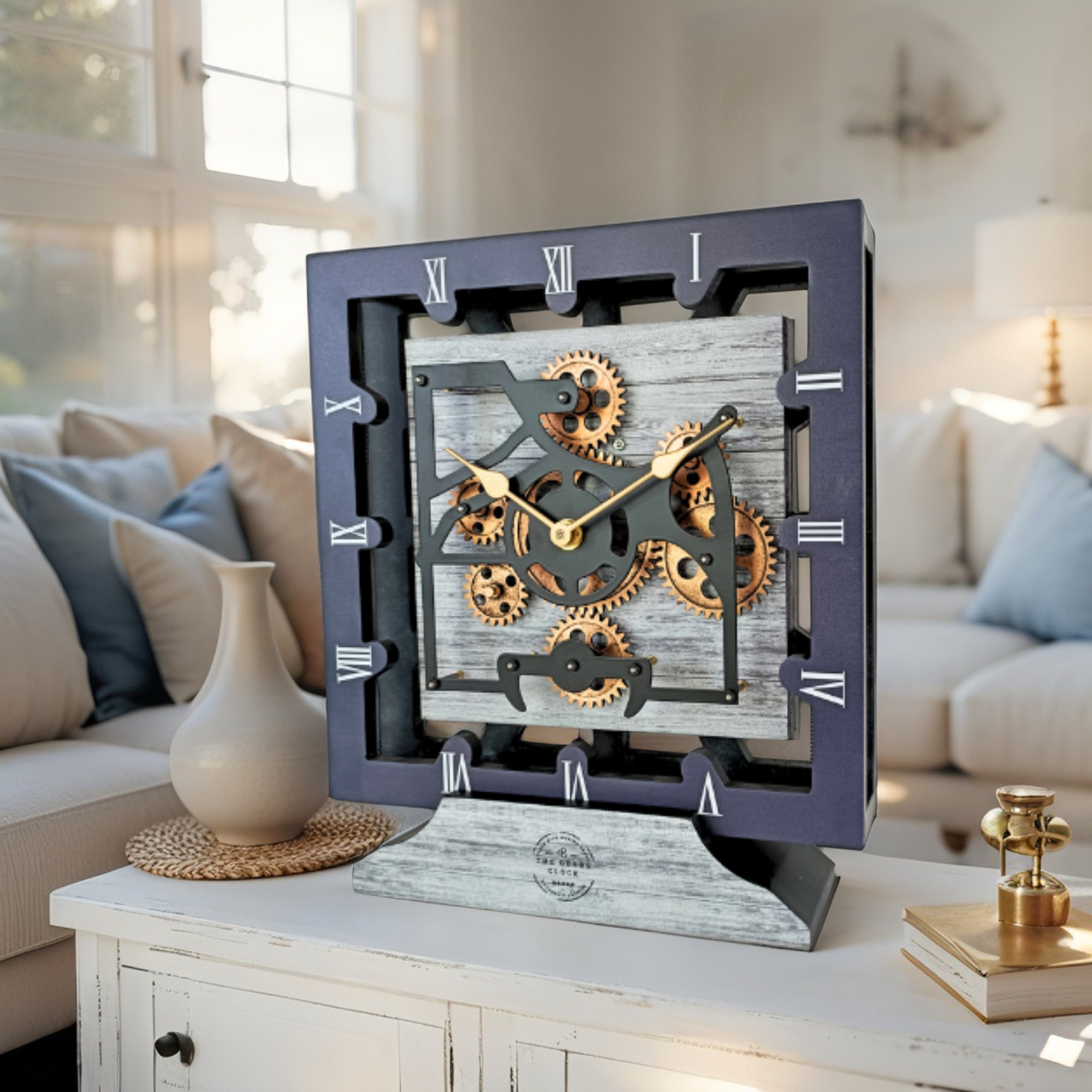
Click here to Shop the CANADA LINE DESK CLOCK SQUARE (HYBRID WALL) 10 INCH SILVER GREY
Several clocks in The Gears Clock Canada Line are described as "convertible" — they function as both a freestanding desk or mantel clock and a wall-mounted clock, switching between modes via a detachable base. Understanding how the movement sits inside these pieces helps explain why the conversion works so cleanly.
The quartz movement and gear train are housed in the clock body itself — the base is purely a structural support that keeps the clock upright on a flat surface. When the base is detached and the clock is hung on a wall, the mechanism continues to function identically because nothing about the movement's operation depends on orientation in the way an old pendulum clock did. Quartz stepping motors work equally well horizontal, vertical, or at any angle. The gears are mounted on fixed axles and rotate regardless of how the clock is positioned in space.
This is worth understanding if you're considering the Canada Line Desk Clock Square in Aqua Green (10-inch) or the Canada Line Desk Clock Square in Silver Grey (10-inch) — both 10-inch (25 cm) square convertible pieces. On a desk, they sit upright on the detachable base and draw the eye with their gear motion at work-surface height. Moved to a wall for a different layout or season, you simply remove the base, mount the clock with the included hardware, and the mechanism performs exactly as before. No recalibration, no re-leveling of a pendulum, no adjustment of any kind. The timekeeping is continuous through the transition as long as batteries remain seated.
Similarly, the round Canada Line Desk Clock in Vintage Black (10-inch) brings the same convertible engineering in a circular silhouette — 25 cm across — for those who prefer a softer profile on the desk or wall. The Vintage Black colorway tends to read as more industrial or masculine against light walls, while the Aqua Green reads lighter and more expressive. The movement inside is the same in both cases.
Why This All Matters When You're Choosing a Clock
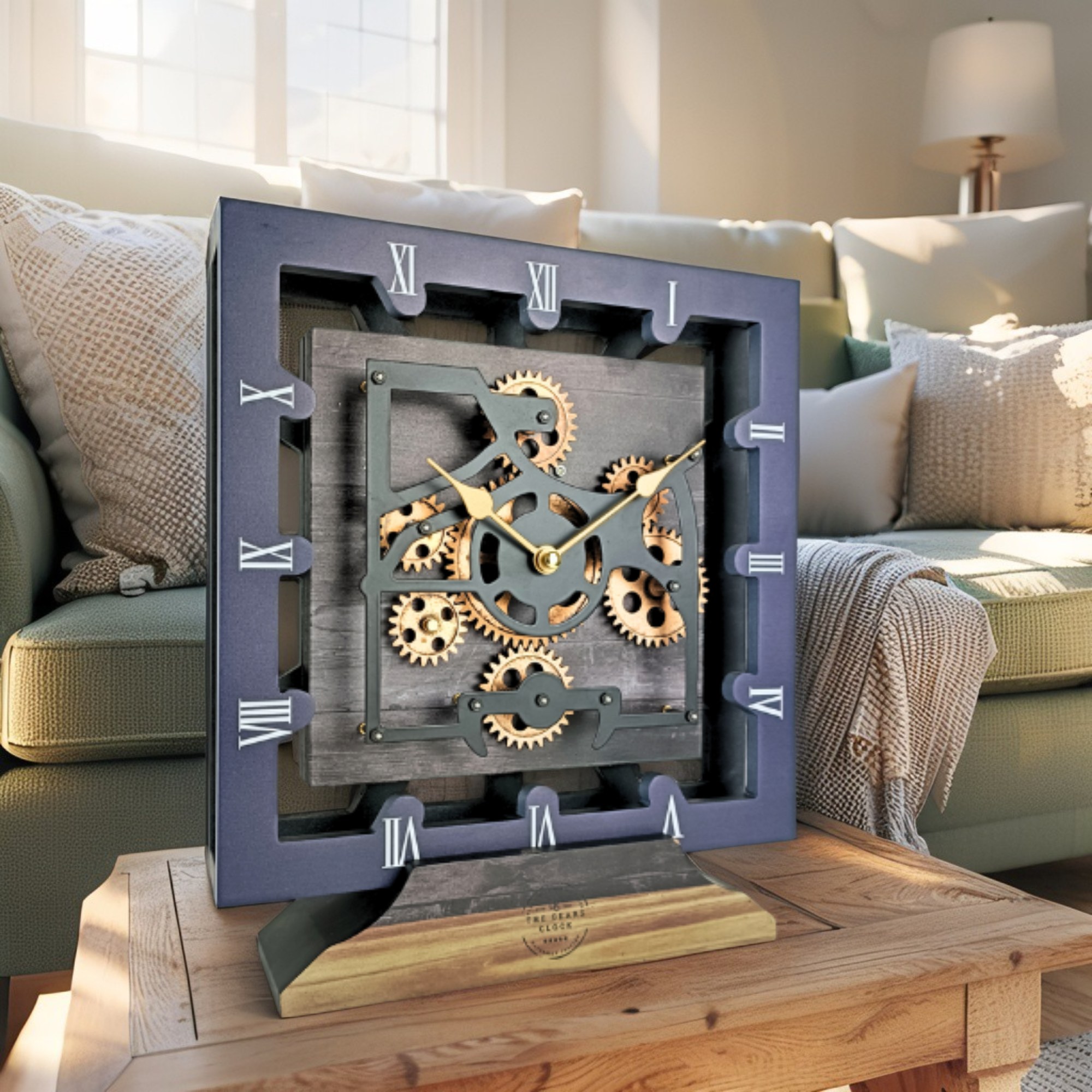
Click here to Shop the CANADA LINE DESK CLOCK SQUARE (HYBRID WALL) 10 INCH VINTAGE BLACK
Understanding the mechanism makes you a more confident buyer. When you know that the gears are genuinely functional — not decorative appliqué — you understand why the clock looks alive rather than merely decorated. When you know the quartz oscillator is what keeps it accurate, you understand why these clocks don't need winding, regulation, or professional servicing under normal use. When you know the stepping motor is what makes the sound profile so quiet, you can place the clock anywhere in your home without worrying about a ticking soundtrack.
It also reframes how you think about the clock's presence on the wall. The motion you're watching isn't a gimmick. It's the same gear-train physics that has driven mechanical clocks for centuries, paired with the precision and reliability of modern quartz oscillation. The result is something that rewards a long look — the kind of object that earns a place on a wall not just because it fills space, but because it genuinely does something worth watching.
At The Gears Clock, that combination of craft and engineering is the whole point. Whether you're considering a compact 10-inch convertible for a home office desk or a 22-inch statement piece like the Stockholm for a living room wall, the mechanism inside is designed to be as enduring as it is beautiful.
Shop the collection: Canada 10 inch Clock Desk-Wall Square · CLOCK BY COLOR - BROWN
Keep exploring:
- How to Style a Moving-Gear Wall Clock in the Bedroom (Without It Feeling Like a Waiting Room)
- The Home Office Clock: How to Make Time Visible Without Killing Your Workspace Vibe
- The Dining Room Statement Clock: How to Style a 36-Inch Moving-Gear Clock Above a Sideboard or Open Wall
Frequently Asked Questions
Do I need to wind or service a moving-gear clock from The Gears Clock?
No. All Gears Clock moving-gear clocks use quartz movements powered by standard batteries — there is no winding, no mainspring to tension, and no routine mechanical servicing required. Replace the batteries when the movement slows or stops, keep the gears free of heavy dust buildup, and the clock will run reliably for years.
Can the convertible clocks (like the 10-inch Canada Line desk clocks) be switched between desk and wall mode without stopping the clock?
Yes, as long as the batteries remain seated during the transition, the movement continues running. Detach the base, hang the clock on the wall using the included mounting hardware, and timekeeping is uninterrupted. The quartz movement operates independently of orientation, so no re-setting is needed after mounting.
Why do some moving-gear clocks have two battery compartments?
The timekeeping movement (which drives the hands) and the gear display mechanism can have different power draw characteristics. Separating them into two compartments allows each to run optimally and independently, extending overall battery life and ensuring that one function running low doesn't immediately affect the other. It's normal for the two sets of batteries to need replacement at different times.


