










Twice a year, a strange thing happens. We either lose an hour of sleep to the void or gain one back from nowhere. Clocks jump forward in spring and fall back in autumn, and for a few days afterward, many of us feel subtly jet-lagged, a little off, as though the world has shifted one gear without telling the rest of the machinery. If you've ever wondered why we do this at all — and whether it's actually doing what it was supposed to — you're not alone. The story behind Daylight Saving Time is more complicated, more contested, and more fascinating than most people realize.
Where the Idea Actually Came From

Click here to Shop the ITALY LINE WALL CLOCK SQUARE 24 INCH SORRENTO
The most popular origin story credits Benjamin Franklin, who in 1784 wrote a satirical letter to a Parisian journal suggesting that people could save candle wax if they simply woke up when the sun rose instead of sleeping through the morning light. It was a joke, really — a sharp-elbowed piece of humor at the expense of Parisian society's late-sleeping habits. Franklin never proposed changing the clocks. He proposed changing people.
The true architect of modern Daylight Saving Time was a New Zealand entomologist named George Vernon Hudson, who in 1895 proposed a two-hour shift so he'd have more evening daylight to collect insects after his postal shift ended. Then, independently, a British builder named William Willett campaigned tirelessly in the early 1900s for the idea of advancing clocks in summer — not to save candles, but because he couldn't stand the waste of Londoners sleeping through bright summer mornings while the evenings dimmed early. Willett died in 1915, a year before Britain finally adopted his idea. He never saw it happen.
Germany was actually the first country to implement DST nationally, on April 30, 1916, as a wartime measure to conserve coal during World War I. Britain and most of Europe followed weeks later. The United States adopted it in 1918, dropped it, reinstated it chaotically during World War II, and didn't standardize it federally until the Uniform Time Act of 1966. The history is less a story of rational planning than of war economies, competing local interests, and a lot of improvisation.
The Arguments For It — and Why They're Shakier Than They Sound

Click here to Shop the ITALY LINE WALL CLOCK ROUND 24 INCH ATRANI
The central promise of Daylight Saving Time has always been energy savings. By shifting an hour of daylight into the evening, people theoretically use less artificial light at night. In an era of candles and incandescent bulbs, that logic held reasonable weight. In 2025, it holds considerably less.
A landmark 2008 study by the National Bureau of Economic Research examined energy use in Indiana — a state that had recently adopted DST statewide after previously observing it only in parts — and found that electricity consumption actually increased after DST was adopted. Longer summer evenings meant more air conditioning use in the evenings, which more than offset any lighting savings. Other studies have found similarly modest or even negative effects on energy consumption in modern economies, where lighting is already highly efficient and climate control is the dominant energy load.
The economic arguments are more nuanced. Retailers and outdoor recreation industries have historically been among DST's strongest advocates, because more evening daylight means more shopping, more golf, more time at restaurants after work. The golf industry alone famously lobbied for the 1986 extension of DST in the US, reportedly citing hundreds of millions of dollars in additional revenue. Evening light is genuinely good for the economy of leisure. Whether that benefit justifies the disruption — twice a year, for every person in the country — is a much harder calculation.
What the Science Says About the Health Cost

Click here to Shop the CANADA LINE DESK CLOCK ROUND (HYBRID WALL) 10 INCH VINTAGE BLACK
Here is where the evidence becomes genuinely hard to ignore. The spring transition — when clocks spring forward and everyone loses one hour of sleep — is associated in the research literature with a measurable spike in several troubling outcomes. Studies have found increases in heart attacks in the days immediately following the spring change. Traffic accident rates rise. Workplace injuries tick upward. Stroke hospitalizations increase. Judges, in one remarkable study, were found to hand down longer prison sentences in the days after the spring shift, plausibly because sleep-deprived decision-making is harsher.
The mechanism is not mysterious. Human beings have a circadian clock — a deep biological rhythm anchored to light and darkness — and that clock does not simply update like a smartphone when governments move the hands of time. It adjusts slowly, at a rate of roughly fifteen to thirty minutes per day. Losing an hour of sleep abruptly in spring is the equivalent of flying one time zone east overnight, except you didn't choose to fly anywhere. Your body expects light and darkness at certain times, and suddenly they've been rescheduled.
Most sleep scientists and chronobiologists who study DST professionally have reached a remarkably consistent conclusion: the twice-yearly disruption causes measurable harm, and the world would be better off choosing a permanent time and staying there. Where they disagree is on which permanent time — permanent standard time, which aligns more closely with the sun's actual position, or permanent summer time, which keeps the evening light that so many people enjoy. That debate, it turns out, is just as political as the original decision to change the clocks.
How to Actually Adjust When the Clocks Change

Click here to Shop the ITALY LINE WALL CLOCK ROUND 36 INCH FURORE
While governments continue debating whether to abolish DST entirely, the clocks will almost certainly keep changing for the foreseeable future. The practical question then becomes: how do you make the transition without spending a week feeling foggy and slightly misaligned?
The most effective strategy is to begin adjusting before the change happens, not after. Starting three to four days before the spring forward, shift your bedtime and wake time fifteen minutes earlier each day. By the time the clocks change, your body has already done most of the work. The same principle works in reverse for the fall back — though that direction is considerably gentler, since gaining sleep is far easier on the body than losing it.
Light is your most powerful tool for resetting your circadian rhythm. Bright morning light suppresses melatonin and advances your internal clock, which is exactly what you need in spring. Make a point of getting outside or near a bright window as early as possible in the morning in the days surrounding the spring transition. Conversely, dim your home lighting in the hour before bed — and put down the phone. The blue-wavelength light from screens tells your brain it's still midday, which is the last thing you need when you're already working against a disrupted rhythm.
Your meals and exercise schedule matter more than most people realize. The circadian system is sensitive not just to light but to eating and movement. Keeping your meals and your exercise at consistent times — even when the clocks have shifted — gives your body's internal clock additional anchoring cues to resynchronize against.
And here is a small but genuinely meaningful thing: when the clocks change, do your whole home at once. Change every clock before you go to bed on the night of the transition, so that when you wake up the next morning, every clock you look at tells the same story. Inconsistency between clocks creates a subtle but real cognitive friction — a little jolt of disorientation each time you move from room to room — and eliminating that friction is one less thing pulling your internal clock in the wrong direction.
The Clock on Your Wall Matters More Than You Think

Click here to Shop the SWEDEN LINE WALL CLOCK ROUND 22 INCH "STOCKHOLM" LEATHER BROWN-GOLD
There's something worth sitting with here. We live in an era when time is technically visible everywhere — on our phones, on our laptops, on the microwave, in the corner of every screen. And yet twice a year, millions of people genuinely lose track of what time it is for days. They oversleep. They arrive early for things. They feel vaguely out of step with the rest of the world. The proliferation of digital time displays has not, it turns out, made us more anchored to time. If anything, the opposite — because a phone is something you look at for reasons other than the time, and the time is a detail among a hundred distractions rather than the point of the glance.
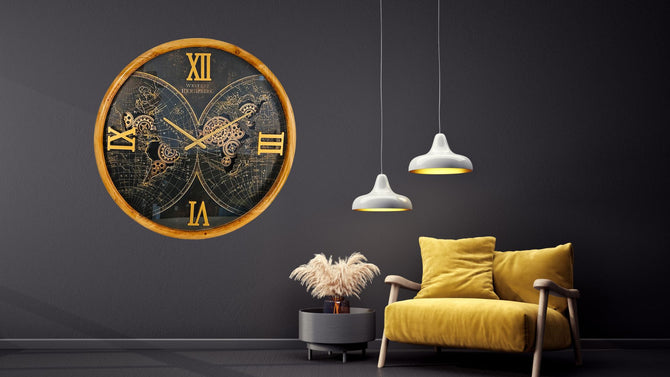
An analog wall clock does something different. It gives time a place in your home — a fixed, ambient, always-visible presence that doesn't require you to pick anything up or unlock anything. During a transition week, when your body and your schedule are slightly out of sync, that steady visual anchor matters. The clock on the wall is not competing for your attention with notifications. It is simply, quietly, telling you where you are.
At The Gears Clock, we design wall clocks that are built to be exactly that kind of presence — pieces that fit naturally into the rhythm of a home, not just as decoration, but as instruments that make daily life feel more intentional and more grounded. When you change your clocks this season, make it a moment to appreciate the one on your wall. It has been keeping time through seasons and shifts, through spring-forwards and fall-backs, without missing a beat.


)